“I hate that they’re manipulating me.
I hate how they’re using music to make me feel something about the words.”
“No you don’t. You hate that they’re doing it badly.
You notice the incongruity because you don’t feel the same about the words,
or not as much, as you do about the music.”
“—which means they have to use the music to back up the cruddy words!”
(And these internal dialogues distract me from the words in the first place...)
Wednesday, May 18, 2011


Saturday, May 14, 2011
All I can offer you for following me is following me itself
Kind of a cool dream, walking with Jesus. I only remember a couple quotes.
Jesus: Will you follow me?
Me: I want to, but it would mean leaving behind the people I love?
Jesus: Some of them are coming; indeed, some are already further along, and the only way to reach them is to follow me.
Jesus: All I can offer you for following me is following me itself.
Jesus: Will you follow me?
Me: I want to, but it would mean leaving behind the people I love?
Jesus: Some of them are coming; indeed, some are already further along, and the only way to reach them is to follow me.
Jesus: All I can offer you for following me is following me itself.
Sunday, April 24, 2011
One Day
Wrote while seeing Handel's Messiah, but it suits today, too.
One Day
Because there really was a time
when God was dead,
and heaven broke,
and evil had forever won,
the Earth committed to the devil’s rule,
and all that had been made, was made to decay.
But nothing carries on
for long that way:
I gather that it lasted
only one full day.
One Day
Because there really was a time
when God was dead,
and heaven broke,
and evil had forever won,
the Earth committed to the devil’s rule,
and all that had been made, was made to decay.
But nothing carries on
for long that way:
I gather that it lasted
only one full day.
Saturday, April 02, 2011
untitled, but addressed to God
You, you are like hurricane eye
(and everything outside it)
You, you are like stars in the day
see me even when you’re invisible
You, you are like radio signal
I tune in and you are there
You, you are like eternal tide
I sit long enough I find you
Thursday, February 24, 2011
random
Phone company texts me my account balance; my credit with them (it's a prepaid plan) is $64.64.
Then I do the KenKen puzzle and two adjacent boxes catch my eye, 24x and 10+; in a 6x6 puzzle, both have only one solution: 6,4.
I go downstairs to put on music while I write, and I load my music library; at the bottom of the screen it reads "6464 items selected".
Uh... but anyway, random. Why do I notice these things...
Then I do the KenKen puzzle and two adjacent boxes catch my eye, 24x and 10+; in a 6x6 puzzle, both have only one solution: 6,4.
I go downstairs to put on music while I write, and I load my music library; at the bottom of the screen it reads "6464 items selected".
Uh... but anyway, random. Why do I notice these things...
for the nose
poem I rummaged up (summer 2009) (very perplexing)
...
the big nose
Life is a big nose—
a too big
and rife with danger
“Poetry Is My Country
and I Canst Not Change Her”
nose
In some hour of need where the flowers grew
God bless those blanketed by snow
God bless the snows that lie atop our sparrow;
what use was its nose?
But in my hour of need when I plant the seed
the warmful air is stirred by sparrow’s wing (offering);
I inhale the country of the poetry,
I inhale it when it snows
but life is not worth living for;
you live it for the nose
...
you guys noses are not even that great
Sunday, January 23, 2011
ides of March and other lucky days
(Disclaimer: unless you're in a particularly generous and contemplative mood, this post is longer than its topic warrants.)
Shakespeare's Julius Caesar—a hilarious comedy, if your name is Brutus.
Caesar:
Who is it in the press that calls on me?
I hear a tongue shriller than all the music*
Cry "Caesar!" Speak, Caesar is turn'd to hear.
Soothsayer:
Beware the ides of March.
The link tells you some cool facts about the history of the "ides", but the short version is: in March it's the 15th.
Caesar's supposed to beware it because he gets stabbed to death—as the Wikipedia article notes, "23 times". None too shabby, guys. None too shabby.
I met two girls lately. One of them was briefly involved with me, so briefly that it requires a subordinate clause containing the word, in November. Not any more. The other girl I've been slightly more careful with in terms of friendship.
Once in December the second girl and I were talking about special days or something and it occurred to me I didn't know the birthday of the first one. So I said to my friend, "By the way, what's your birthday?"
"March 16th," she said, and I, since I am a nerd who always has the most random references from literature in the back of his head, thought, Whew! close.
The next time I saw the first girl (on less romantic terms than in the past), I asked when hers was. "November." — "Oh! Did I miss it? I should have asked." — "No, I've made a habit of not telling people. I think none of my recent friends knows when it is. You were there, though." I wasn't sure, but I had a vague suspicion I had accidentally chosen that day to give the worst birthday present ever. But anyway, it was an interesting idea—not telling anyone.
With this second girl, so far I've taken an approach of complete honesty and openness. Well, I usually do—I'm no good at keeping secrets, especially about myself—but this is more intentional. She knows far more about me than a recent friend should, to be honest (har har). It's even become a topic of discussion, since she considers herself to have "the bad habit" of not doing the same, but "telling people what they want to hear".
"But," she said, "you're making me better in some ways."
Which made my heart smile a little.
But when she called me today, I'd just gotten home from a long day at work and was feeling a little uneasy. She brought up the subject of going out to see special events together, such as a classical music concert (which she'd like to try), and asked me when my birthday was, with somewhat ambiguous implications.
"July, right?" she said, and for some reason I held my breath. "The eleventh?"
I exhaled, smiled, and hesitated. Finally, I said, "Close—but nope."
I feel mischievous. I'm gonna hold on to this one for now.
*How could I not make specific mention of the amazing poetry of this line?
Shakespeare's Julius Caesar—a hilarious comedy, if your name is Brutus.
Caesar:
Who is it in the press that calls on me?
I hear a tongue shriller than all the music*
Cry "Caesar!" Speak, Caesar is turn'd to hear.
Soothsayer:
Beware the ides of March.
The link tells you some cool facts about the history of the "ides", but the short version is: in March it's the 15th.
Caesar's supposed to beware it because he gets stabbed to death—as the Wikipedia article notes, "23 times". None too shabby, guys. None too shabby.
I met two girls lately. One of them was briefly involved with me, so briefly that it requires a subordinate clause containing the word, in November. Not any more. The other girl I've been slightly more careful with in terms of friendship.
Once in December the second girl and I were talking about special days or something and it occurred to me I didn't know the birthday of the first one. So I said to my friend, "By the way, what's your birthday?"
"March 16th," she said, and I, since I am a nerd who always has the most random references from literature in the back of his head, thought, Whew! close.
The next time I saw the first girl (on less romantic terms than in the past), I asked when hers was. "November." — "Oh! Did I miss it? I should have asked." — "No, I've made a habit of not telling people. I think none of my recent friends knows when it is. You were there, though." I wasn't sure, but I had a vague suspicion I had accidentally chosen that day to give the worst birthday present ever. But anyway, it was an interesting idea—not telling anyone.
With this second girl, so far I've taken an approach of complete honesty and openness. Well, I usually do—I'm no good at keeping secrets, especially about myself—but this is more intentional. She knows far more about me than a recent friend should, to be honest (har har). It's even become a topic of discussion, since she considers herself to have "the bad habit" of not doing the same, but "telling people what they want to hear".
"But," she said, "you're making me better in some ways."
Which made my heart smile a little.
But when she called me today, I'd just gotten home from a long day at work and was feeling a little uneasy. She brought up the subject of going out to see special events together, such as a classical music concert (which she'd like to try), and asked me when my birthday was, with somewhat ambiguous implications.
"July, right?" she said, and for some reason I held my breath. "The eleventh?"
I exhaled, smiled, and hesitated. Finally, I said, "Close—but nope."
I feel mischievous. I'm gonna hold on to this one for now.
*How could I not make specific mention of the amazing poetry of this line?
Saturday, January 22, 2011
romance
is among the most complicated things on Earth
if you let it be
I'm gonna have to let it be
(damn)
well, I guess one of us must know (sooner or later) ...
if you let it be
I'm gonna have to let it be
(damn)
well, I guess one of us must know (sooner or later) ...
Monday, December 20, 2010
triptych
I see myself -- I mean my SELF -- as three parts.
Mind does my reasoning, makes puns, learns facts, and is how I consciously act.
Heart feels emotions, makes friendships, cares about little things in life.
Soul talks to God, and complains to him, too. It's the only moral part.
Most of the time I just listen to my mind. It's easy and comfortable.
Sometimes the soul gets a word in. It's rarer than it should be though.
Now, as anyone who reads this knows, I tend to oversensitize, overdramatize, and generally see too much tragedy in life.
So most of the time, I get through life by ignoring my heart. There are times when it won't shut up, and then I end up writing good poetry. (Yeah, I try to write poetry the rest of the time. Forgive me for that!)
There have. however, been times when I haven't needed to ignore it or shut it up. The past couple days have been one such time.
Jesus replied: Love the Lord your God with all your heart and with all your soul and with all your mind. This is the first and greatest commandment.
Sunday, December 12, 2010
knowledge and not knowledge
Well, there's that, too.
I learned this morning about the importance of doing God's will with joy, not just doing God's will.
I always thought at least that, the sacrifice, was untouchably right.
In reality it was among the worst of what I did.
I let a person down and called it righteousness.
May God know that,
however blind, ignorant, and harmful it turned out,
I only ever tried to be good --
to her, to him, to Him.
I only ever loved.
Have mercy on my intentions.
This is for you,
everyone.
I learned this morning about the importance of doing God's will with joy, not just doing God's will.
I always thought at least that, the sacrifice, was untouchably right.
In reality it was among the worst of what I did.
I let a person down and called it righteousness.
May God know that,
however blind, ignorant, and harmful it turned out,
I only ever tried to be good --
to her, to him, to Him.
I only ever loved.
Have mercy on my intentions.
This is for you,
everyone.
Saturday, December 11, 2010
sharing and not sharing
Tonight I observed that I keep nothing of myself back
but am honest with everyone who asks
(and even some who don't)
I have no idea what a secret is.
However, I didn't realize
not everything in my head is mine
I got a lot of it from other people and it's hard to tell
to whom what I have belongs
this has led to some mistakes,
some terrible.
I would go on but I can't
but am honest with everyone who asks
(and even some who don't)
I have no idea what a secret is.
However, I didn't realize
not everything in my head is mine
I got a lot of it from other people and it's hard to tell
to whom what I have belongs
this has led to some mistakes,
some terrible.
I would go on but I can't
Saturday, December 04, 2010
written in stone
At some point the past becomes unalterable.
It petrifies into history.
Then you write it down,
the startling facts.
Did I just say the past becomes unalterable?
It petrifies into history.
Then you write it down,
the startling facts.
Did I just say the past becomes unalterable?
Tuesday, November 30, 2010
God is good
God is good!
Jonah 2:9:
Don't give me peace, Lord. Don't take away the difficulty.
Make me strong enough for it.
Acts 4:29:
If I don't take this disgrace in hand, that would be the real dishonour.
Acts 5:41:
And sure, people will say I'm treating this whole thing too seriously. "Not everything has to do with being a good person. Just enjoy life for once." Hm...
2 Peter 3:10-11:
1 Peter 3:17:
2 Corinthians 4:17:
And in any case, whatever else happens, God is there.
Isaiah 41:13:
Jonah 2:9:
"But I, with shouts of grateful praise,
will sacrifice to you.
What I have vowed I will make good.
I will say, 'Salvation comes from the LORD.' "
Don't give me peace, Lord. Don't take away the difficulty.
Make me strong enough for it.
Acts 4:29:
Now, Lord, consider their threats and enable your servants to speak your word with great boldness
If I don't take this disgrace in hand, that would be the real dishonour.
Acts 5:41:
The apostles left ... rejoicing because they had been counted worthy of suffering disgrace for the Name
And sure, people will say I'm treating this whole thing too seriously. "Not everything has to do with being a good person. Just enjoy life for once." Hm...
2 Peter 3:10-11:
The day of the Lord will come like a thief. The heavens will disappear with a roar; the elements will be destroyed by fire, and the earth and everything done in it will be laid bare. Since everything will be destroyed in this way, what kind of people ought you to be? You ought to live holy and godly lives.Besides, there's no good way out of this one and you and I both know it.
1 Peter 3:17:
It is better ... to suffer for doing good than for doing evil.Not that anything I'm experiencing can really be called suffering, of course.
2 Corinthians 4:17:
...our light and momentary troubles [the believers were being physically and psychologically persecuted]If what he and the apostles were going through was "light and momentary", who am I to complain about this small thing?!
And in any case, whatever else happens, God is there.
Isaiah 41:13:
For I am the LORD your God
who takes hold of your right hand
and says to you, Do not fear;
I will help you.
Saturday, November 27, 2010
thanks
In the last year or so I've read very little fiction (though I miss it). Most of what I've read, outside of school, has actually been C.S. Lewis. I just love his writing, his sensibility, and his talent for making difficult problems clear and pithy. Among the best are: the first book of Mere Christianity, Surprised by Joy, and The Four Loves (though I did also read his fiction; Till We Have Faces is amazing).
One of the most interesting things, however, was his collected letters. You really get to know him, and he was an even more interesting person than his philosophical writing suggests. But anyway, I was thinking of this quote, but I forgot to whom he wrote it or under what circumstances:
"When we pray, it seems ridiculous that we would ever have more things to ask for than to be thankful for. But I think we tend to prefer prayers that ask for thing after thing after thing -- forgetting the vast number of prayers that have been answered" (or something to that effect).
Compare with Thomas à Kempis in The Imitation of Christ:
"Looking at this world, the good man always has something to be sorrowful about."
Hmmm... I think they both have a point.
One of the most interesting things, however, was his collected letters. You really get to know him, and he was an even more interesting person than his philosophical writing suggests. But anyway, I was thinking of this quote, but I forgot to whom he wrote it or under what circumstances:
"When we pray, it seems ridiculous that we would ever have more things to ask for than to be thankful for. But I think we tend to prefer prayers that ask for thing after thing after thing -- forgetting the vast number of prayers that have been answered" (or something to that effect).
Compare with Thomas à Kempis in The Imitation of Christ:
"Looking at this world, the good man always has something to be sorrowful about."
Hmmm... I think they both have a point.
Saturday, November 20, 2010
In the Sky
Discovered this tidbit among my notes a few weeks ago, though I don't remember writing it...
(Translated from the original French)
(Translated from the original French)
There was once a boy who loved to look, from his window, at the sky. He visited it often during the day to see outside, whether it was blue or cloudy. But his friends thought it was not good for a boy to do so; and when he said he was dreaming at the window, they replied that it was not good to dream. This he could not understand, and one by one his friends left him.
So afflicted was he by the loss of his friends that he decided to never again turn his eyes to the sky, not ever, but to travel the world, and from time to time stay in a little village or cottage that he'd find, and inquire whether someone would want to become his friend. He lived like this for three years.
There were some people who told him, “Go,” curtly; others who gave him bread and milk; and some others who invited him to their home to stay the night, the poor lad. But each night he closed his eyes to prevent them from seeing the stars and pulling him into a dream again. And nobody offered to be his friend.
At the end of the three years spent like that, the boy thought, “I find friends neither at night nor in the daytime. How then does one find a friend?” And, because he understood that he could not go on anymore, he stopped walking as he'd been doing. And he stayed where he was for a long time.
One day in the morning the boy slept, lying on the ground beside a little tree. And something strange happened to him: he felt himself dreaming. He took pleasure in this dream, because he dreamed that he was flying in the air, in the sky, where he had always wanted to live and spend his days.
Suddenly he was rudely awakened. A girl was there; she had bumped into him. She said, “Sorry! I’m so clumsy... I was looking up.”
Thursday, November 18, 2010
The Sun said to the Tempest, Be Still; I Will Remove the Jacket
to be read quickly aloud
We knew, some time ago, a man who thought himself a writer
We knew, some time ago, a man who thought himself a writer
and a poet and a servant of the Lord and tried to show it, but
we all knew it wasn’t true; we thought it was not good for him
to lead himself astray, and so we asked the angels and some other
rather shady folk to send a thousand tests his way until he either saw
what we was not—or, if he overcame, became
the things he thought he’d always been.
the things he thought he’d always been.
But the results were unforeseen. He neither failed the tests nor could
we really say in fairness that he’d borne the harness and succeeded;
he never recognized the tests or realized their significance.
Indeed he took the hook each time we looked and put it in his pocket
and forgot it, putting it aside and saving it for later. Then since
the man absorbed our every test, unloading every night the things
he’d stuffed into his pocket—coins and string and all manner of whatnot
besides the tests themselves—on his dresser, we gave it up at last,
abandoning the thought that he could be corrected. He thanked God
each night for the various odd phenomena which “faith hath brought”
(he didn’t know of our existence) “from the rich and blessing hand
of God”. The latter rarely said a thing in answer; we assume He didn’t
know any better than the man did of the tests and how we planned them.
However, one of us one day got the idea to make a test of will,
namely that the test itself would be, whether he should take the test at all;
that is to say, we laid a lovely trial on the ground to judge him whether
he would pick it up when he had found it; would he put it in his pocket—
you see, he’d vowed when he was young to take whatever God would
give him, graciously; but now we took that vow and turned it round,
delivering for once, instead of pain and suffering which he ignored,
a gift, too lovely to be true, disguised as being from his Lord. We’d see
if he would take the bait and only know it was temptation once it was
too late. And thusly, said the craftiest among us, we will wait.
He came upon it while he went from one place to another.
It caught his eye and gave him pause and contemplation.
“Normally my God delivers unto me the simple things,”
he mused, “unprecious things—or so it’s been since my salvation—
which I have borne and borne and borne; perhaps He’s bored
by this; or else perhaps he’s satisfied? Perhaps this new thing’s a reward?”
And so he justified its taking, as if given by the Lord,
instead of us.
instead of us.
And instantly he fell in love, the moment he had picked it up.
Exactly as we’d thought, it took him over, grabbed his soul
and made him worship it instead of God; and we were pleased,
and gave him, for our sport, the gift of writing, and of poetry, and of
considering himself a righteous person and a servant of the Lord.
And there was joy on earth, and peace, and everything that mankind
has inherently adored; and there was happiness in Hell.
Wednesday, November 17, 2010
going, staying, being, praying
I haven't said anything here for a little while.
It feels like I began life about two months ago and ended it now.
Not, of course, that Luke is dead. Far from it. But the person who temporarily lived here is moving out. And I myself will come back in after.
Sigh.
I liked having some company.
I've only even remotely resembled a good person for about the last 30 hours (and not nearly all of them), and it's not a lot of fun.
I never realized before that if it's easy to be good, you're not doing enough...
But through it all, I feel closer to God, anyway.
(I've never felt particularly close to Him, except on a few rare occasions. I'm too intellectual for that; I come to understand some point of theology, back it up from the Bible, answer questions, and have no idea who or what God is.)
But when you think you don't need Him, He breaks you and damn sure you'll come crawling back.
And rightly so. He's the only light or reason I can rely on right now.
God, please override my will with your own... I don't know how to do it, but I want to.
If, that is, He reads my blog... pretty sure nobody does! :P
It feels like I began life about two months ago and ended it now.
Not, of course, that Luke is dead. Far from it. But the person who temporarily lived here is moving out. And I myself will come back in after.
Sigh.
I liked having some company.
I've only even remotely resembled a good person for about the last 30 hours (and not nearly all of them), and it's not a lot of fun.
I never realized before that if it's easy to be good, you're not doing enough...
But through it all, I feel closer to God, anyway.
(I've never felt particularly close to Him, except on a few rare occasions. I'm too intellectual for that; I come to understand some point of theology, back it up from the Bible, answer questions, and have no idea who or what God is.)
But when you think you don't need Him, He breaks you and damn sure you'll come crawling back.
And rightly so. He's the only light or reason I can rely on right now.
God, please override my will with your own... I don't know how to do it, but I want to.
If, that is, He reads my blog... pretty sure nobody does! :P
Sunday, October 24, 2010
Amen!
So I was reading today and one British character says:
Ignoring what he actually said, I looked at the "Quite" and remembered what I recently read about the history of the word "Amen":
And I wondered if, linguistically, "Quite" has the same function?
Imagine if the Brits had been the chosen people instead of the Jews.
"You and I want to be the people who do the taking charge, not the ones who are taken charge of. Quite."
Ignoring what he actually said, I looked at the "Quite" and remembered what I recently read about the history of the word "Amen":
"Originally from Hebrew and pronounced omein, meaning "Truth!", the word was spoken after somebody said something which everyone strongly agreed with."
And I wondered if, linguistically, "Quite" has the same function?
Imagine if the Brits had been the chosen people instead of the Jews.
"Our father, who art in heaven, hallowed be thy name.
Thy kingdom come; thy will be done on earth, as it is in heaven;
give us this day our daily bread, and forgive us our trespasses,
as we forgive those who trespass against us.
Lead us not into temptation, but deliver us from evil.
Quite!"
Thursday, October 07, 2010
foliage
overheard:
A: Come on, guys,... like, we can walk in the park and look at the foilage--
B: "Foilage"? Did you say "foilage"?
A: What?
(I think I know what he'll say next)
B: What a nerdy word!
(I was wrong)
(I think this makes me a worse nerd)
.
.
Nope, not much new.
A: Come on, guys,... like, we can walk in the park and look at the foilage--
B: "Foilage"? Did you say "foilage"?
A: What?
(I think I know what he'll say next)
B: What a nerdy word!
(I was wrong)
(I think this makes me a worse nerd)
.
.
Nope, not much new.
Sunday, September 05, 2010
multi-disciplined
Well, countdown is less than 2 days. Anxiety, excitement, readiness, etc etc etc
Courses lie in French, Education, Philosophy, and, er, a spare half credit in Writing.
How I wish I could be paid to philosophize, or write, without having some more tedious and useful backup ...
(On doit avoir une raison pour parler français -- plus forte que `je peux l`enseigner`)
I`m starting a new job copy-editing for the Erindale campus`s student newspaper, The Medium.
(If you don`t happen to know what copy-editing is, it`s
1. Fix basic grammar and spelling mistakes
2. Make formatting and style conform to Canadian Press Style
3. Make sure no words or sentences are excruciatingly bad.
e.g. from `It was reported by the Huffington Post that the Clash will prefrom on Thurs 7:00PM.`
to `The Huffington Post reported that The Clash will perform at 7 p.m. on Thursday.`)
You might think it`s incredibly boring, but for someone whose one area of expertise is the particulars of written English, it`s actually quite stimulating and -- dare I say it -- enjoyable. And the hours fit in with my schedule wonderfully. And the pay is fair, and heaven knoweth I must pay my tuition somehow...
Nice people, too. I don`t know if I was slightly less introverted than usual, or if they`re just great people (or both), but I feel like I`ve made at least 2 or 3 `coworker` friends so far, and everyone else seems nice.
There is a yellow truck beside me. A plushy yellow truck
One story that I had to edit was absolutely brilliant, and I mentioned this to one of the editors over Pad Thai. He said excitedly, `Oh yeah? You liked that??`. It turned out it was his own story, under a synonym [sic]. He was thoroughly pleased -- I couldn`t just have been complimenting him out of niceness, since I didn`t know it was his -- and I convinced him to use his real name. If I can get the story next week (once the current issue of The Medium is outdated) I`ll post it for you here...
Anyway, tomorrow I think I`ll get together with an old friend, maybe help out finishing the deck on the last day of summer (our family`s on-and-off project these last few months) and listen to Beethoven`s 6th on my mp3 player in the hammock, if the weather will grant us a genuine send-off for the summer...
I`ve rambled a bit. But anyway, I hope your summer has been as simultaneously relaxing and productive as mine, and have a good school year, my dear friends. I`d love to hear from or see you whenever there`s time!
Courses lie in French, Education, Philosophy, and, er, a spare half credit in Writing.
How I wish I could be paid to philosophize, or write, without having some more tedious and useful backup ...
(On doit avoir une raison pour parler français -- plus forte que `je peux l`enseigner`)
I`m starting a new job copy-editing for the Erindale campus`s student newspaper, The Medium.
(If you don`t happen to know what copy-editing is, it`s
1. Fix basic grammar and spelling mistakes
2. Make formatting and style conform to Canadian Press Style
3. Make sure no words or sentences are excruciatingly bad.
e.g. from `It was reported by the Huffington Post that the Clash will prefrom on Thurs 7:00PM.`
to `The Huffington Post reported that The Clash will perform at 7 p.m. on Thursday.`)
You might think it`s incredibly boring, but for someone whose one area of expertise is the particulars of written English, it`s actually quite stimulating and -- dare I say it -- enjoyable. And the hours fit in with my schedule wonderfully. And the pay is fair, and heaven knoweth I must pay my tuition somehow...
Nice people, too. I don`t know if I was slightly less introverted than usual, or if they`re just great people (or both), but I feel like I`ve made at least 2 or 3 `coworker` friends so far, and everyone else seems nice.
There is a yellow truck beside me. A plushy yellow truck
One story that I had to edit was absolutely brilliant, and I mentioned this to one of the editors over Pad Thai. He said excitedly, `Oh yeah? You liked that??`. It turned out it was his own story, under a synonym [sic]. He was thoroughly pleased -- I couldn`t just have been complimenting him out of niceness, since I didn`t know it was his -- and I convinced him to use his real name. If I can get the story next week (once the current issue of The Medium is outdated) I`ll post it for you here...
Anyway, tomorrow I think I`ll get together with an old friend, maybe help out finishing the deck on the last day of summer (our family`s on-and-off project these last few months) and listen to Beethoven`s 6th on my mp3 player in the hammock, if the weather will grant us a genuine send-off for the summer...
I`ve rambled a bit. But anyway, I hope your summer has been as simultaneously relaxing and productive as mine, and have a good school year, my dear friends. I`d love to hear from or see you whenever there`s time!
Thursday, June 10, 2010
Moment[ous]
It’s the end of the year and I’m looking forward but also back.
So much has happened.
I remember last year around this time, or two months before it, when I was applying for university. University of Toronto Mississauga was one choice. The other one I took seriously was Ryerson. For acting.
At the Ryerson audition, I was among all the applicants, and I remember the room so well. We had to perform two things: a play shortened to two minutes, and a monologue. I’d prepared my monologue well in advance and polished it and worked on it for weeks. (Later, this same monologue, when I performed it in drama class, got an A. It was from Shakespeare.)
So I got up and did my play—Chekhov’s “The Seagull” in three minutes. The audience laughed a lot. Another person also did The Seagull and mine went over at least as well; even the director we were auditioning for laughed.
... But just before I did my monologue, something clicked in my head. I thought, "I should improvise a monologue. These people are clearly into funny things more than serious ones." I felt the decision very strongly and didn’t think a second time. So I did it, I made it up as I went.
It was... meh.
I wouldn’t even repeat it now for you.
But it seemed like such a good idea.
And what’s happened since? I was turned down by Ryerson. I went to UTM. I took all kinds of classes, some of which really meant a lot to me. I spent countless hours in the car, talking to my brother and my mum. I met a ton of people -- and friends. I did challenging work and had the occasional epiphany at school. In short, I went on a new course in life and changed from who I was to who I am. And I am vastly different in some ways than I was before all this.
Why?
Because of two seconds, and not more, when I thought, “I should improvise this thing.”
Two seconds decided this entire last year, from the people I now happily call my friends, to the amazing things I’ve learned, to the person I’ve become.
(Of course maybe I wouldn’t have made the program anyway... but hey, Peters had faith in that monologue!)
And looking back at the end of this year, all I can think is,
maybe it wasn’t so stupid to have (accidentally!) thrown the audition after all.
It’s been good.
To y'all who are attentive: yes this is from a while before today, but I thought it should be here, too
So much has happened.
I remember last year around this time, or two months before it, when I was applying for university. University of Toronto Mississauga was one choice. The other one I took seriously was Ryerson. For acting.
At the Ryerson audition, I was among all the applicants, and I remember the room so well. We had to perform two things: a play shortened to two minutes, and a monologue. I’d prepared my monologue well in advance and polished it and worked on it for weeks. (Later, this same monologue, when I performed it in drama class, got an A. It was from Shakespeare.)
So I got up and did my play—Chekhov’s “The Seagull” in three minutes. The audience laughed a lot. Another person also did The Seagull and mine went over at least as well; even the director we were auditioning for laughed.
... But just before I did my monologue, something clicked in my head. I thought, "I should improvise a monologue. These people are clearly into funny things more than serious ones." I felt the decision very strongly and didn’t think a second time. So I did it, I made it up as I went.
It was... meh.
I wouldn’t even repeat it now for you.
But it seemed like such a good idea.
And what’s happened since? I was turned down by Ryerson. I went to UTM. I took all kinds of classes, some of which really meant a lot to me. I spent countless hours in the car, talking to my brother and my mum. I met a ton of people -- and friends. I did challenging work and had the occasional epiphany at school. In short, I went on a new course in life and changed from who I was to who I am. And I am vastly different in some ways than I was before all this.
Why?
Because of two seconds, and not more, when I thought, “I should improvise this thing.”
Two seconds decided this entire last year, from the people I now happily call my friends, to the amazing things I’ve learned, to the person I’ve become.
(Of course maybe I wouldn’t have made the program anyway... but hey, Peters had faith in that monologue!)
And looking back at the end of this year, all I can think is,
maybe it wasn’t so stupid to have (accidentally!) thrown the audition after all.
It’s been good.
Friday, May 14, 2010
no I did not write that sir
I may have written about everything
about as in somewhere in the area of
not about as in concerning
I may be in fact the origin of all literature
or somewhere quite close to all
it’s verily amazing
how I managed this
up to and including nine thousand years ago
when I appear to be oh around eighteen now
the secret is that I believed in myself
people told me I could do anything if
I only only only BUHLEEVED in myself
this did I do
now I have authored every work ever
oh, every classic novel
it turned out to be quite easy
you try it
you be their author
author them
author your life
also don’t steal my idea
I think it’s pretty cool
thanks
except Twilight
I didn’t author Twilight
thank God
about as in somewhere in the area of
not about as in concerning
I may be in fact the origin of all literature
or somewhere quite close to all
it’s verily amazing
how I managed this
up to and including nine thousand years ago
when I appear to be oh around eighteen now
the secret is that I believed in myself
people told me I could do anything if
I only only only BUHLEEVED in myself
this did I do
now I have authored every work ever
oh, every classic novel
it turned out to be quite easy
you try it
you be their author
author them
author your life
also don’t steal my idea
I think it’s pretty cool
thanks
except Twilight
I didn’t author Twilight
thank God
Friday, May 07, 2010
river flows in[to the C]
you guys I am not that great at readin' piano music
therefore since I could not find it
I transposed
RIVER FLOWS IN YOU by YIRUMA
into the delightfully easy key of C Major
and so then I thought, "maybe someone else would also like this"
here you go
Piano score, just for you
a silly orchestration experiment
.
P.S. there are many repetitions; it is the fault of yiruma
P.S. I put in 1 tiny accident on purpose; if you find it you win
therefore since I could not find it
I transposed
RIVER FLOWS IN YOU by YIRUMA
into the delightfully easy key of C Major
and so then I thought, "maybe someone else would also like this"
here you go
Piano score, just for you
a silly orchestration experiment
.
P.S. there are many repetitions; it is the fault of yiruma
P.S. I put in 1 tiny accident on purpose; if you find it you win
Saturday, May 01, 2010
and call it God
There is something in my heart, much, much older than me, it feels. Like many, I mistook it for a particular part of the world, once. At times it seemed like the ocean, or the way the sun goes through the clouds in some skies, or a single, perfect tree, in its summer and spring array, above a forest into blue. The yearning for my childhood, sometimes, or the feeling one gets when one is barefoot in the grass on a summer’s day before a storm.
I didn’t really become conscious of this thing until I was fifteen or so, and, on the advice of a friend, I went for (my first intentional!) walk into the deepest nature I could find near my house... I still remember the sight. It was early fall, and the leaves were still fresh and falling in many colours on the ground and on the path. But it was what was off the path that caught my eye. I was gazing at this and that as I walked, and then, looking up, I beheld it through the foliage—a fallen tree, in a patch of sunlight, probably created by the death of its own branches; yet propped up over a little hill; and the sunlight was like heaven falling down, and I desired to climb the tree,—strangely—and get as high up, as close to the source of that sun, as possible. My breath caught, and I felt my eyes sting; I ran to it, I scrambled up it, alone there in the woods, and bruised myself, but carried on, and reached the top, as high as I might go, and still the light was around me and not for me, everywhere and uncapturable; and I began to sob with wild abandon, and I descended and had to sit beneath a tree. The leaves were still falling, and as I regained my senses, I thought, “Yet somehow I did reach paradise... look at this around me; is this not what they call God?”
I thought little more of it then, but stood still in bliss for some minutes, before going on my way. The moment passed, but the memory of it has never passed, and even as I tell it to you a great emotion wells up in me and seizes me,... Such beauty, such undeniable beauty...
There were a few more moments like that, yes, few, and far between. There was another time in the same woods, one summer, when at the bottom of a hill I became conscious of the light pouring in from the top, and realized I was lost, and realized that I did not know what was beyond it, and wanted desperately to see it. My breath is coming in snatches now.—Again I ran; I ran up the hill, through broken sticks and over stones, desperate to get over it; and as I later described to the one I love, “Somehow I thought God was over that hill. And somehow I thought ... Heaven is there; and I am ready. I give up everything, all my possessions, all my feelings, and health, and the people, for what is over that hill.” Pardon me: I am crying. I stumbled over the ridge, and... Not much was there. A little bit of undergrowth, more forest, some rugged patches. Nothing I did not have at the bottom. I went away in silence. Yet shortly after, as I paused to breathe, the feeling snuck up on me. The great burst of Longing, which was to me as Heaven. Did I not say, “Surely God was there”?
Or there was another time, as I was mowing the lawn at someone’s house by a field, and there was a little hummock I had not noticed; over it hung a giant tree, through whose spring leaves fell such sunsetting twilight as ever anyone wanted, and I pushed the mower absentmindedly toward it, and bordering it was a broken-down wooden fence, and beyond it, a vast and open field, all covered in gold, waving, waving gold, and I stopped and stared, mouth open in anguish. I loved that anguish.
These times became further and further apart, and I thought of them less and less. By and by it came to be that when I experienced it, I thought to tell someone when I got home, but by the time I did get back I had already forgotten it. It escaped my reach. Lately other things, these things I mentioned to you, began to take over, particularly my childhood and the idea of my innocence now wizened. But it too yielded nothing, and could yield nothing. What would I have done even if it had been the most perfect location I was brought to, by any of these things? Sat there? Admired it? Wished I was elsewhere? No; none of these things were really it.
There is no place one can go to that satisfies it. There is a desire, a painful and sweet desire. I said to the one I love, “This sorrow I feel—it is almost like joy; it is pure emotion; I feel sure it is greater than joy or sorrow, and I only have no name for it.” This desire, perhaps a need, comes to life at certain sights, and sometimes sounds and smells and touches, and for some people, tastes. But when have they ever gone to the thing they saw, listened to the music on its own, found the source of the smell, or held what they wished, that it stayed that way forever? For me, it never, never stayed, even for an instant. Only one thing did: the longing, and the feeling that something else existed beyond, which somehow I attained not in the getting, but in the longing itself. Having was wanting; and wanting was having.
(That is also what I felt, in one of these moments, today. I was biking in the cool, fragrant air—there are many sweet-smelling trees around here—and the sun broke a cloud and spilt it all over a forest scene, playing it over the river, and I was forced to stop moving and stop breathing. That is why I am so happy now.)
As C.S. Lewis said, “If we consider our natures so that nothing is there without reason—which is plausible in theism, deism, and atheism; everything but chaosism—if we have a desire that nothing on Earth can fill, the most likely explanation is that it is not Earth we were made for.”
Indeed, I have tried to fill it with so much. Many people do. With reading, writing, music, sexuality, gaming, the idea of the nature walk itself; with depression, which was convincing because it felt so close to that original sorrow, though in reality was nothing like it; with friends, summer days, intellectualism, fine cuisine, the development of a strong and healthy body, and everything else. Romance was the greatest killer for me, and it supported many of those others, too. For some people it’s gambling, for others wealth, for others perfectionism; thank goodness I am not gifted with any talent in any of those. But nothing lasts, and nothing, when I have it, is what I thought it would be, or does for me what I thought it would. It is all a falling-through.
Yet there is some enjoyment in it. This is the enjoyment I feel when I have heard of a new thing, and am going to pursue it: when I decide I may find What I’m Looking For in it. Between hearing of it and having it, I want it; and I think many people would agree that this is the sweetest part of the whole affair, the thinking one will get, one will have—in future, one will be.
How then shall I keep chasing after these things, when I have seen and understood that what I really desire is desire itself? And how is it that I can long after this longing? How is it so much better than whatever I find on Earth?—It is perhaps from something higher; for the best thing is to have That Which Is On High, and the next best is to Know Of It (even subconsciously) and to Seek It. The worst of all is to live in our current unfulfilling world, and say that good rests in it; to be a swine far from pearls.
I will thus seek that which I know must be the only thing that /can/ fulfil this desire, and give up seeking all else: I mean if I can, I will. I will try to. If there is nothing there, at least I will have stopped wasting my time trying to fill this Hole with more nothing. And if there is something there, this is the only way, God willing, that I shall at least find what I seek, and call it God.
I didn’t really become conscious of this thing until I was fifteen or so, and, on the advice of a friend, I went for (my first intentional!) walk into the deepest nature I could find near my house... I still remember the sight. It was early fall, and the leaves were still fresh and falling in many colours on the ground and on the path. But it was what was off the path that caught my eye. I was gazing at this and that as I walked, and then, looking up, I beheld it through the foliage—a fallen tree, in a patch of sunlight, probably created by the death of its own branches; yet propped up over a little hill; and the sunlight was like heaven falling down, and I desired to climb the tree,—strangely—and get as high up, as close to the source of that sun, as possible. My breath caught, and I felt my eyes sting; I ran to it, I scrambled up it, alone there in the woods, and bruised myself, but carried on, and reached the top, as high as I might go, and still the light was around me and not for me, everywhere and uncapturable; and I began to sob with wild abandon, and I descended and had to sit beneath a tree. The leaves were still falling, and as I regained my senses, I thought, “Yet somehow I did reach paradise... look at this around me; is this not what they call God?”
I thought little more of it then, but stood still in bliss for some minutes, before going on my way. The moment passed, but the memory of it has never passed, and even as I tell it to you a great emotion wells up in me and seizes me,... Such beauty, such undeniable beauty...
There were a few more moments like that, yes, few, and far between. There was another time in the same woods, one summer, when at the bottom of a hill I became conscious of the light pouring in from the top, and realized I was lost, and realized that I did not know what was beyond it, and wanted desperately to see it. My breath is coming in snatches now.—Again I ran; I ran up the hill, through broken sticks and over stones, desperate to get over it; and as I later described to the one I love, “Somehow I thought God was over that hill. And somehow I thought ... Heaven is there; and I am ready. I give up everything, all my possessions, all my feelings, and health, and the people, for what is over that hill.” Pardon me: I am crying. I stumbled over the ridge, and... Not much was there. A little bit of undergrowth, more forest, some rugged patches. Nothing I did not have at the bottom. I went away in silence. Yet shortly after, as I paused to breathe, the feeling snuck up on me. The great burst of Longing, which was to me as Heaven. Did I not say, “Surely God was there”?
Or there was another time, as I was mowing the lawn at someone’s house by a field, and there was a little hummock I had not noticed; over it hung a giant tree, through whose spring leaves fell such sunsetting twilight as ever anyone wanted, and I pushed the mower absentmindedly toward it, and bordering it was a broken-down wooden fence, and beyond it, a vast and open field, all covered in gold, waving, waving gold, and I stopped and stared, mouth open in anguish. I loved that anguish.
These times became further and further apart, and I thought of them less and less. By and by it came to be that when I experienced it, I thought to tell someone when I got home, but by the time I did get back I had already forgotten it. It escaped my reach. Lately other things, these things I mentioned to you, began to take over, particularly my childhood and the idea of my innocence now wizened. But it too yielded nothing, and could yield nothing. What would I have done even if it had been the most perfect location I was brought to, by any of these things? Sat there? Admired it? Wished I was elsewhere? No; none of these things were really it.
There is no place one can go to that satisfies it. There is a desire, a painful and sweet desire. I said to the one I love, “This sorrow I feel—it is almost like joy; it is pure emotion; I feel sure it is greater than joy or sorrow, and I only have no name for it.” This desire, perhaps a need, comes to life at certain sights, and sometimes sounds and smells and touches, and for some people, tastes. But when have they ever gone to the thing they saw, listened to the music on its own, found the source of the smell, or held what they wished, that it stayed that way forever? For me, it never, never stayed, even for an instant. Only one thing did: the longing, and the feeling that something else existed beyond, which somehow I attained not in the getting, but in the longing itself. Having was wanting; and wanting was having.
(That is also what I felt, in one of these moments, today. I was biking in the cool, fragrant air—there are many sweet-smelling trees around here—and the sun broke a cloud and spilt it all over a forest scene, playing it over the river, and I was forced to stop moving and stop breathing. That is why I am so happy now.)
As C.S. Lewis said, “If we consider our natures so that nothing is there without reason—which is plausible in theism, deism, and atheism; everything but chaosism—if we have a desire that nothing on Earth can fill, the most likely explanation is that it is not Earth we were made for.”
Indeed, I have tried to fill it with so much. Many people do. With reading, writing, music, sexuality, gaming, the idea of the nature walk itself; with depression, which was convincing because it felt so close to that original sorrow, though in reality was nothing like it; with friends, summer days, intellectualism, fine cuisine, the development of a strong and healthy body, and everything else. Romance was the greatest killer for me, and it supported many of those others, too. For some people it’s gambling, for others wealth, for others perfectionism; thank goodness I am not gifted with any talent in any of those. But nothing lasts, and nothing, when I have it, is what I thought it would be, or does for me what I thought it would. It is all a falling-through.
Yet there is some enjoyment in it. This is the enjoyment I feel when I have heard of a new thing, and am going to pursue it: when I decide I may find What I’m Looking For in it. Between hearing of it and having it, I want it; and I think many people would agree that this is the sweetest part of the whole affair, the thinking one will get, one will have—in future, one will be.
How then shall I keep chasing after these things, when I have seen and understood that what I really desire is desire itself? And how is it that I can long after this longing? How is it so much better than whatever I find on Earth?—It is perhaps from something higher; for the best thing is to have That Which Is On High, and the next best is to Know Of It (even subconsciously) and to Seek It. The worst of all is to live in our current unfulfilling world, and say that good rests in it; to be a swine far from pearls.
I will thus seek that which I know must be the only thing that /can/ fulfil this desire, and give up seeking all else: I mean if I can, I will. I will try to. If there is nothing there, at least I will have stopped wasting my time trying to fill this Hole with more nothing. And if there is something there, this is the only way, God willing, that I shall at least find what I seek, and call it God.
Thursday, April 29, 2010
philosophy incomplete -- mostly for my own keeping; venture in at your own risk
By the way, by the end of this, you'll see why I think it was quite unnecessary for you to read it at all. Just a helpful note :)
---
There are of course two parts of our knowledge: the Correct and the Useful. One would think that they almost always overlap, but one is much closer to us than the other. That is to say, nearly everyone has and acts on the Useful every single day, whereas they have little idea of the Correct; therefore they cannot be exactly the same, if you can have one and not the other.
Now philosophers are trying to divine what is the Correct, and non-philosophers are not. (I say this because it is how I define “philosopher” -- a person who is trying to seek the Correct. I don't mean that the Correct is limited to academic people, not at all.) This means that the average person, the non-philosopher, is not likely to end up with the Correct; but his common sense will bring the Useful.
For example, the philosophy of what is a “fact” is very complex, and very deeply connected to a lot of other things, and has a lot of implications for life. But a person's intuition about a “fact” already generally suits them, and is generally enough to get by on from day to day (sometimes we are deceived, more often our beliefs approximate reality, so far as the Correct calls it, anyway!). This is what I mean by the Useful, then: intuition which yields a workable version of the Correct, without much of the hard work and thinking needed to arrive at the Correct.
Since the Correct is almost always out of reach, and in most philosophical subjects it really is, as far as we know, it is certainly Useful for philosophers to treat the Correct -- more accurately, “what we know of the Correct” -- as incomplete, and so far, almost useless. Many philosophers have tried to alter their reality by (what we now realize was) an incomplete the Correct, and it turns out horribly. Frankly, our Logic and Reason has not yet caught up with our more mysterious Intuition in the discovery of the Correct. Therefore, a philosopher ought to have a grasp of the Useful because, it yielding a better idea so far, it will otherwise contaminate itself by mixing with our Logic and Reason's version of the Correct.
Shall I say it more simply? In summary, philosophers should leave their philosophy out of their life, because (so far) their intuition is more often right about stuff.
---
Nevertheless, the non-philosophers should not pretend to know the Correct, simply because it falls in line with their Intuition. They are not philosophers, because they do not seek the Correct at all: they claim to have found it, and worse, without having done any seeking in the first place. For example, our Intuition leads us to a Useful and workable understanding of the "fact"; but it knows nothing of the process and half-steps on which light is thrown by Logic and Reason, and has no idea where it went wrong, whereas in the Correct one know incompletely but (if done properly) never be mistaken. Those who claim to know the true nature of something which in fact has only been given them by their Intuition -- to call their Useful the "real Correct" -- are quite intolerable to me.
---
This begs another, shorter, line of thought as well. Why ought we not immediately alter our life by what we've so far found in the Correct? One might say, "I've found that something I do is actually not Correct; I should change it." But why does the evidence tend to this conclusion? Since Intuition works very well, in general, in our lives, we should assume that it is very well, in general, correct about our lives. It follows that before asking "Look at my philosophy! Is something wrong with my life?", we should ask "But look at my life; since my philosophy disagrees, is it inadequate so far?"
For example, say I am told, "People feel guilty about eating animals; this is because killing them is wrong. There is something to what people feel. Therefore, you should be a vegetarian." It is quite true that a feeling of guilt should give a stigma to whatever we feel guilty about. And this is how many vegetarian arguments run. The conclusion is similarly added to, "Therefore, if you are eating animals, you should feel guilty." But say I don't feel guilty in the first place: should I artificially manufacture the premise, because the conclusion is appealling? Not at all! If the premise is false in the real world, all it shows is that it's a bad explanation for the real world; when the premise is false in the real world, all that it means it that we should abandon the conclusion, not the real world.
Shall I say it more simply? In summary, philosophy should first concern itself with explaining "why it is how it is," because our best knowledge accepts that it is how it seems to be. Only secondly it should concern itself with "how it ought to be" -- only after it understands why it is how it is in the first place. So when philosophy disagrees with the facts, we need not try and change the facts, but realize the incompleteness of our philosophy.
---
By gum, if you patiently followed along this far, thanks. You have just earned the Badge of the Right to Disagree with Everything I Just Said. Congratulations!
---
There are of course two parts of our knowledge: the Correct and the Useful. One would think that they almost always overlap, but one is much closer to us than the other. That is to say, nearly everyone has and acts on the Useful every single day, whereas they have little idea of the Correct; therefore they cannot be exactly the same, if you can have one and not the other.
Now philosophers are trying to divine what is the Correct, and non-philosophers are not. (I say this because it is how I define “philosopher” -- a person who is trying to seek the Correct. I don't mean that the Correct is limited to academic people, not at all.) This means that the average person, the non-philosopher, is not likely to end up with the Correct; but his common sense will bring the Useful.
For example, the philosophy of what is a “fact” is very complex, and very deeply connected to a lot of other things, and has a lot of implications for life. But a person's intuition about a “fact” already generally suits them, and is generally enough to get by on from day to day (sometimes we are deceived, more often our beliefs approximate reality, so far as the Correct calls it, anyway!). This is what I mean by the Useful, then: intuition which yields a workable version of the Correct, without much of the hard work and thinking needed to arrive at the Correct.
Since the Correct is almost always out of reach, and in most philosophical subjects it really is, as far as we know, it is certainly Useful for philosophers to treat the Correct -- more accurately, “what we know of the Correct” -- as incomplete, and so far, almost useless. Many philosophers have tried to alter their reality by (what we now realize was) an incomplete the Correct, and it turns out horribly. Frankly, our Logic and Reason has not yet caught up with our more mysterious Intuition in the discovery of the Correct. Therefore, a philosopher ought to have a grasp of the Useful because, it yielding a better idea so far, it will otherwise contaminate itself by mixing with our Logic and Reason's version of the Correct.
Shall I say it more simply? In summary, philosophers should leave their philosophy out of their life, because (so far) their intuition is more often right about stuff.
---
Nevertheless, the non-philosophers should not pretend to know the Correct, simply because it falls in line with their Intuition. They are not philosophers, because they do not seek the Correct at all: they claim to have found it, and worse, without having done any seeking in the first place. For example, our Intuition leads us to a Useful and workable understanding of the "fact"; but it knows nothing of the process and half-steps on which light is thrown by Logic and Reason, and has no idea where it went wrong, whereas in the Correct one know incompletely but (if done properly) never be mistaken. Those who claim to know the true nature of something which in fact has only been given them by their Intuition -- to call their Useful the "real Correct" -- are quite intolerable to me.
---
This begs another, shorter, line of thought as well. Why ought we not immediately alter our life by what we've so far found in the Correct? One might say, "I've found that something I do is actually not Correct; I should change it." But why does the evidence tend to this conclusion? Since Intuition works very well, in general, in our lives, we should assume that it is very well, in general, correct about our lives. It follows that before asking "Look at my philosophy! Is something wrong with my life?", we should ask "But look at my life; since my philosophy disagrees, is it inadequate so far?"
For example, say I am told, "People feel guilty about eating animals; this is because killing them is wrong. There is something to what people feel. Therefore, you should be a vegetarian." It is quite true that a feeling of guilt should give a stigma to whatever we feel guilty about. And this is how many vegetarian arguments run. The conclusion is similarly added to, "Therefore, if you are eating animals, you should feel guilty." But say I don't feel guilty in the first place: should I artificially manufacture the premise, because the conclusion is appealling? Not at all! If the premise is false in the real world, all it shows is that it's a bad explanation for the real world; when the premise is false in the real world, all that it means it that we should abandon the conclusion, not the real world.
Shall I say it more simply? In summary, philosophy should first concern itself with explaining "why it is how it is," because our best knowledge accepts that it is how it seems to be. Only secondly it should concern itself with "how it ought to be" -- only after it understands why it is how it is in the first place. So when philosophy disagrees with the facts, we need not try and change the facts, but realize the incompleteness of our philosophy.
---
By gum, if you patiently followed along this far, thanks. You have just earned the Badge of the Right to Disagree with Everything I Just Said. Congratulations!
Wednesday, April 21, 2010
What a Piece of Work is a Cat
The animal whose territory largely overlaps our house we call our pet. Before today, I might have said, “Our pet lives with us,” or something of the sort; but since then I’ve seen that he is quite an independent creature—as much as you or me. We’re not bound to our houses, to our rooms, to our beds, and neither is a cat. I say a cat; for though dogs often defend their territory ferociously, and claim too much, they still admit it belongs to their human. Not so the cat. The cat tolerates, but would never submit to, the human. The cat thinks of you as an animal it has to live with, as you might think of a flock of birds that come and peck at your lawn now and then; or even as he might think of that same flock of birds on a day when the sun is too hot, and he’s too lazy, to kill one.
We have kept this wild beast for some thirteen years, at the start of which he barely weighed anything. What a piece of work is a cat! Not even as big as the mugs my father took everywhere, filled with coffee and other drinks I was too young for, left to collect in great quantities in the back seat of the car. I distinctly remember this kitten crawling into one such mug, a big blue one, with no room to turn around, and too young and stupid to figure out walking backwards. We pitied it. We freed it. In return, we received the wounds he felt appropriate punishment for our acts.
Not that these were our first stripes, not that this was our first cat. Two years prior, for Dad’s birthday, we had also adopted a kitten. The first one was meant to be ours forever. It was a vicious thing and attacked a car with verve, in what were of course the last seconds of its life. His name was either Jack or Jake, depending on whether you ask a male or female member of our family, and he is buried not quite six feet deep, under our old garden, in a shoebox, along with some of us children’s dear trinkets. The second cat was meant to be ours forever. It was vapid and sleepy. The poor girl, named Sahara for the Sahara Desert, never did anything besides sleep, eat, and move from bed to bed. When the basement door was unlocked, you would wake up in your bed with disturbingly warm feet, and no apparent cause; but if you leaned over quick enough you’d see her trotting out of the room to lie on some other dreamer’s appendages. She was that sort of cat. One day she was sleeping, as the story goes, in the road; and we wasted no ultra soft Kleenex on her remains but only hosed down the asphalt. Our dad dug up the old shoebox in the garden, and added the corpse of our latest victim; he did it so the children would not see the shoebox held only bones and trinkets.
The third year, the third cat. Now, as for this one!—It was meant to be ours forever.
Actually, he easily proved himself the better of cars. I have journals from twelve years ago that detail his intelligence, his ability to “look both ways”, and his healthy love of life. Though in fact I don’t recall him ever crossing the road, a strategy that has worked well, at any rate. There is an old story among us children that he once saved his mortal enemy (“The Orange Cat”, from down the road) when the latter was in danger of being run over; he leapt at the imbecilic creature and pushed it out of the way. Later the story seemed implausible, and we decided that the real reason for the move had been to attack The Orange Cat, and his salvation was only indirect. Nowadays the story only bears a kind of nostalgia, the nostalgia of a time when we believed and acted as if such things were true. It glows faintly with the inviolability of childhood, but it is quite dead.
Nevertheless, this third cat, whose name is Butterscotch, has survived quite a lot in his thirteen years. There were the two weeks during which we could not even guess his sex and Steve Ballmer, who shared a name with the Microsoft executive, and built model castles, and eventually married a woman he met while playing an online game: Steve examined the sexless kitten and declared it to be male, and suggested a clinic to get him neutered. There was the time he climbed over the cement wall in our crawlspace and disappeared for two days, at the end of which he finally reduced himself to begging, and his meowing freed him. There was the time he disappeared for an entire winter and we discovered he had been living with an old woman down the street and only returned to us when she consulted someone who said Butterscotch was not a stray. There was the time he came home with a limp and a huge wound in his side, the size of Jack. There was the time he stayed at our cousins’ house and learned how much he hated their three cats and the cousins clipped his claws without asking us. There was the ride home, graced by his foul-smelling puke. There was the time he was very, very sick and we wept that we might have to put him down.
There was the week in which our monster obliterated birds wherever he found them, leaving in the grass orgiastic trails of organs, blood, and guts spilled on a living lawn. The heart was always eaten: one understands the sacrifice rituals of primitive civilizations only when one has a cat. And one feels to disown the cat. But the neighbours complained bitterly about the birds on their yards, too, and we thought it a bit unfair: the cat did nothing but divorce himself from our ownership, whereas the weight of his crimes fell on us. This is maybe how God felt. There was the first bird, that we buried, like a pet, under the trampoline. There was the last bird, which deserves explanation.
We were downstairs and the ground-level windows to the backyard suddenly released a great cawing, a raucous death-knell, and a glance revealed the trees were full of crows. We of course rushed outside, we children. And on the lawn there was our cat, and a feeble, whimpering bird, two feet from it, petrified. The predator moved closer and closer to the flight-deprived morsel, whose hundred comrades in the sky screamed “Guilty! We find him guilty!” till we could bear it no longer and we jumped out to frighten the cat. We did frighten him and the bird, after all that, just up and flew off anyway. The cat gave us a resentful nod before slinking away beneath the shed.
He killed other things, too, of course. I remember when he was a kitten and, like so many kittens do, he deposited a dead rodent at our door, gazing up at our astonished eyes. I remember we flung it into the trash. I imagine that if cats have hearts, his broke at that moment; and then resented.
Of course there was the time just last week or so when we went out on some affair because the day had bloomed an unexpected sun. The cat, looking to absorb it, ascended the staircase of the shed in the backyard, and crawled upstairs, but the door closed behind him. When we got back, we hardly noticed his absence. Sometime the next afternoon, my father went out to the shed in the rain to get a tool and happened to glance upward; the cat was perched on a table, mewling, his little humanoid face pressed against the window, looking out. A pathetic sight.
I suppose dogs really are the only true pets. Dogs and birds. Cats fall in on the opposite side with lizards and fish and hamsters, who all exist in a separate world belonging to them alone, a world which only overlaps with ours when they get hungry. Our neighbour’s cat once destroyed his computer by pissing in its open case. Its extraordinary value meant nothing to him. And our cousins put down two of their three cats. Those cats came into the world with their eyes closed and they went out blind; they saw for a while in the middle, but didn’t care much for what they saw. That’s the way it is with cats. The only thing from our world that means anything to them is that which they can use. And if they can help it they will change nothing during their life.
This morning I heard a horrible hissing from those same ground-level windows, and I ran out to see. My brother did, too. Behind the glass screen door we saw the goings-on: Butterscotch stood on the deck, hair raised, tail three times its normal size, arching his back and hissing as he might have done ten years ago. Before him stood The Orange Cat in similar battle pose. Perhaps a mutual desire to go away unwounded held them back, perhaps a very old friendship formed when the one saved the other from a gruesome death. Either way, Butterscotch happened to glance up and he saw our faces pressed against the glass, looking out, and his manner instantly relaxed. He slowly, oh, so slowly, turned his side to The Orange Cat, taunting, tempting. We later thought that maybe he knew we would come to his aid. The Orange Cat whined and shuffled his feet; Butterscotch made his way onto the picnic table,—a ghostlike, ethereal being!—and paused. There was silence, and then it broke. Our champion whipped his head around ninety degrees to face The Orange Cat. The latter felt the spectre of death, howled, and leapt terrified off the deck.
This territory belongs to Butterscotch. It is not ours, his home, and ours is not his. That was not the defence of a loyal dog. That was the triumph of the monarch. We once called him “pet.”
But there stands in our garden an old stone lion, perhaps only the size of Butterscotch. This lion’s mouth is open, roaring silently. He sits beneath foliage, and the scattered sunset at the end of the day illuminates him horizontally through the brush; otherwise he is invisible. Lately I have seen Butterscotch sitting and staring at the lion, the king of his kind, as immobile as the statue itself. I think that is how a cat wants to be. During his life he will stand on a pedestal, and, if challenged, defend it—with force if necessary. But from his birth to his death he wishes he could be altogether stone, and so remain in the world from which he comes into ours, and to which he goes again. That is where Butterscotch will be when he lies with Jack (or Jake) and Sahara in the shoebox.
We have kept this wild beast for some thirteen years, at the start of which he barely weighed anything. What a piece of work is a cat! Not even as big as the mugs my father took everywhere, filled with coffee and other drinks I was too young for, left to collect in great quantities in the back seat of the car. I distinctly remember this kitten crawling into one such mug, a big blue one, with no room to turn around, and too young and stupid to figure out walking backwards. We pitied it. We freed it. In return, we received the wounds he felt appropriate punishment for our acts.
Not that these were our first stripes, not that this was our first cat. Two years prior, for Dad’s birthday, we had also adopted a kitten. The first one was meant to be ours forever. It was a vicious thing and attacked a car with verve, in what were of course the last seconds of its life. His name was either Jack or Jake, depending on whether you ask a male or female member of our family, and he is buried not quite six feet deep, under our old garden, in a shoebox, along with some of us children’s dear trinkets. The second cat was meant to be ours forever. It was vapid and sleepy. The poor girl, named Sahara for the Sahara Desert, never did anything besides sleep, eat, and move from bed to bed. When the basement door was unlocked, you would wake up in your bed with disturbingly warm feet, and no apparent cause; but if you leaned over quick enough you’d see her trotting out of the room to lie on some other dreamer’s appendages. She was that sort of cat. One day she was sleeping, as the story goes, in the road; and we wasted no ultra soft Kleenex on her remains but only hosed down the asphalt. Our dad dug up the old shoebox in the garden, and added the corpse of our latest victim; he did it so the children would not see the shoebox held only bones and trinkets.
The third year, the third cat. Now, as for this one!—It was meant to be ours forever.
Actually, he easily proved himself the better of cars. I have journals from twelve years ago that detail his intelligence, his ability to “look both ways”, and his healthy love of life. Though in fact I don’t recall him ever crossing the road, a strategy that has worked well, at any rate. There is an old story among us children that he once saved his mortal enemy (“The Orange Cat”, from down the road) when the latter was in danger of being run over; he leapt at the imbecilic creature and pushed it out of the way. Later the story seemed implausible, and we decided that the real reason for the move had been to attack The Orange Cat, and his salvation was only indirect. Nowadays the story only bears a kind of nostalgia, the nostalgia of a time when we believed and acted as if such things were true. It glows faintly with the inviolability of childhood, but it is quite dead.
Nevertheless, this third cat, whose name is Butterscotch, has survived quite a lot in his thirteen years. There were the two weeks during which we could not even guess his sex and Steve Ballmer, who shared a name with the Microsoft executive, and built model castles, and eventually married a woman he met while playing an online game: Steve examined the sexless kitten and declared it to be male, and suggested a clinic to get him neutered. There was the time he climbed over the cement wall in our crawlspace and disappeared for two days, at the end of which he finally reduced himself to begging, and his meowing freed him. There was the time he disappeared for an entire winter and we discovered he had been living with an old woman down the street and only returned to us when she consulted someone who said Butterscotch was not a stray. There was the time he came home with a limp and a huge wound in his side, the size of Jack. There was the time he stayed at our cousins’ house and learned how much he hated their three cats and the cousins clipped his claws without asking us. There was the ride home, graced by his foul-smelling puke. There was the time he was very, very sick and we wept that we might have to put him down.
There was the week in which our monster obliterated birds wherever he found them, leaving in the grass orgiastic trails of organs, blood, and guts spilled on a living lawn. The heart was always eaten: one understands the sacrifice rituals of primitive civilizations only when one has a cat. And one feels to disown the cat. But the neighbours complained bitterly about the birds on their yards, too, and we thought it a bit unfair: the cat did nothing but divorce himself from our ownership, whereas the weight of his crimes fell on us. This is maybe how God felt. There was the first bird, that we buried, like a pet, under the trampoline. There was the last bird, which deserves explanation.
We were downstairs and the ground-level windows to the backyard suddenly released a great cawing, a raucous death-knell, and a glance revealed the trees were full of crows. We of course rushed outside, we children. And on the lawn there was our cat, and a feeble, whimpering bird, two feet from it, petrified. The predator moved closer and closer to the flight-deprived morsel, whose hundred comrades in the sky screamed “Guilty! We find him guilty!” till we could bear it no longer and we jumped out to frighten the cat. We did frighten him and the bird, after all that, just up and flew off anyway. The cat gave us a resentful nod before slinking away beneath the shed.
He killed other things, too, of course. I remember when he was a kitten and, like so many kittens do, he deposited a dead rodent at our door, gazing up at our astonished eyes. I remember we flung it into the trash. I imagine that if cats have hearts, his broke at that moment; and then resented.
Of course there was the time just last week or so when we went out on some affair because the day had bloomed an unexpected sun. The cat, looking to absorb it, ascended the staircase of the shed in the backyard, and crawled upstairs, but the door closed behind him. When we got back, we hardly noticed his absence. Sometime the next afternoon, my father went out to the shed in the rain to get a tool and happened to glance upward; the cat was perched on a table, mewling, his little humanoid face pressed against the window, looking out. A pathetic sight.
I suppose dogs really are the only true pets. Dogs and birds. Cats fall in on the opposite side with lizards and fish and hamsters, who all exist in a separate world belonging to them alone, a world which only overlaps with ours when they get hungry. Our neighbour’s cat once destroyed his computer by pissing in its open case. Its extraordinary value meant nothing to him. And our cousins put down two of their three cats. Those cats came into the world with their eyes closed and they went out blind; they saw for a while in the middle, but didn’t care much for what they saw. That’s the way it is with cats. The only thing from our world that means anything to them is that which they can use. And if they can help it they will change nothing during their life.
This morning I heard a horrible hissing from those same ground-level windows, and I ran out to see. My brother did, too. Behind the glass screen door we saw the goings-on: Butterscotch stood on the deck, hair raised, tail three times its normal size, arching his back and hissing as he might have done ten years ago. Before him stood The Orange Cat in similar battle pose. Perhaps a mutual desire to go away unwounded held them back, perhaps a very old friendship formed when the one saved the other from a gruesome death. Either way, Butterscotch happened to glance up and he saw our faces pressed against the glass, looking out, and his manner instantly relaxed. He slowly, oh, so slowly, turned his side to The Orange Cat, taunting, tempting. We later thought that maybe he knew we would come to his aid. The Orange Cat whined and shuffled his feet; Butterscotch made his way onto the picnic table,—a ghostlike, ethereal being!—and paused. There was silence, and then it broke. Our champion whipped his head around ninety degrees to face The Orange Cat. The latter felt the spectre of death, howled, and leapt terrified off the deck.
This territory belongs to Butterscotch. It is not ours, his home, and ours is not his. That was not the defence of a loyal dog. That was the triumph of the monarch. We once called him “pet.”
But there stands in our garden an old stone lion, perhaps only the size of Butterscotch. This lion’s mouth is open, roaring silently. He sits beneath foliage, and the scattered sunset at the end of the day illuminates him horizontally through the brush; otherwise he is invisible. Lately I have seen Butterscotch sitting and staring at the lion, the king of his kind, as immobile as the statue itself. I think that is how a cat wants to be. During his life he will stand on a pedestal, and, if challenged, defend it—with force if necessary. But from his birth to his death he wishes he could be altogether stone, and so remain in the world from which he comes into ours, and to which he goes again. That is where Butterscotch will be when he lies with Jack (or Jake) and Sahara in the shoebox.
Sunday, April 18, 2010
Freiheit, Treue
When I was in Sunday school many years ago we had to create these emblematic shields with a cross and some phrase or other.
I wrote two words I happened to think were cool, translations supplied by my mum: Freiheit, Adelheit. (I later learned Adelheit is not a word. It should be Treue.) Either way, it's German for "Freedom, loyalty."
Today I was reminded of it, and reflected on it for the first time in years: "Why did I think freedom and loyalty were the core of Christianity? And can those two even coexist? If you're free, you're free of duty, of rules, of everything that would demand your loyalty. They're practically opposites...?"
But then, maybe it's not what it seems. Maybe in Christianity, the two really are compatible? Maybe there's something "free" about loyalty. Or something of fidelity in freedom. Maybe freedom is a given as a reward for loyalty. Maybe you naturally feel loyalty to someone who gives you freedom. Maybe God gives you the feeling of loyalty but also paradoxically freedom from it. Maybe the God who demands loyalty demands only one duty, that one be free... No; it quickly gets confusing... Maybe we are truly free, but loyalty only means anything,
maybe God gave us true freedom, but loyalty only means anything when it's chosen freely.
Maybe that's the purpose in loyalty. The difference between loyalty and obedience, humanity and machinity.
Loyalty is only meaningful if chosen, loyalty needs freedom to be real.
Little Luke, you may have chosen random stuff, but I don't mind. It may not be core Christian philosophy, but it's part of it: our Trueue means something to God because of our Freiheit.
I wrote two words I happened to think were cool, translations supplied by my mum: Freiheit, Adelheit. (I later learned Adelheit is not a word. It should be Treue.) Either way, it's German for "Freedom, loyalty."
Today I was reminded of it, and reflected on it for the first time in years: "Why did I think freedom and loyalty were the core of Christianity? And can those two even coexist? If you're free, you're free of duty, of rules, of everything that would demand your loyalty. They're practically opposites...?"
But then, maybe it's not what it seems. Maybe in Christianity, the two really are compatible? Maybe there's something "free" about loyalty. Or something of fidelity in freedom. Maybe freedom is a given as a reward for loyalty. Maybe you naturally feel loyalty to someone who gives you freedom. Maybe God gives you the feeling of loyalty but also paradoxically freedom from it. Maybe the God who demands loyalty demands only one duty, that one be free... No; it quickly gets confusing... Maybe we are truly free, but loyalty only means anything,
maybe God gave us true freedom, but loyalty only means anything when it's chosen freely.
Maybe that's the purpose in loyalty. The difference between loyalty and obedience, humanity and machinity.
Loyalty is only meaningful if chosen, loyalty needs freedom to be real.
Little Luke, you may have chosen random stuff, but I don't mind. It may not be core Christian philosophy, but it's part of it: our Trueue means something to God because of our Freiheit.
Tuesday, March 30, 2010
is it you
There is no such thing as a whole not made up of smaller parts.
Ever.
Ever.
Let me try to explain it with a field. The field I'm looking at is one of grass like as you'd find every day in Southern Ontario. Grass is my favourite analogy because because it's really the same everywhere.
If we move in, the field is not a field at all. It's a huge shape formed by variations on how the little lines of grass are placed. Given a big big number of blades of grass, you can make any shape.
Of course it doesn't stop. Molecules, atoms, particles, energy, in unmeasurable units. Which are contributed to by the acting of energy on them. We weren't meant to see parts, but wholes. Our eyes are made to look at mountains, stars, trees.
Which are part of ranges, skies, forests.
You're going to come to the question: what turns parts into a whole? Is it the parts themselves? Is it the whole before it even exists?
Is it a third party observer and changer?
Ask yourself: is it me?
It's everything. All at once. You do it and it's done to you. The real truth of the world is that it's a constant arranging of wholes and parts. Arranging messily, beautifully, uglily -- the whole turbulent democracy.
I am a whole, and I am also a part.
I am Rachel of the Fields.
Ever.
Ever.
Let me try to explain it with a field. The field I'm looking at is one of grass like as you'd find every day in Southern Ontario. Grass is my favourite analogy because because it's really the same everywhere.
If we move in, the field is not a field at all. It's a huge shape formed by variations on how the little lines of grass are placed. Given a big big number of blades of grass, you can make any shape.
Of course it doesn't stop. Molecules, atoms, particles, energy, in unmeasurable units. Which are contributed to by the acting of energy on them. We weren't meant to see parts, but wholes. Our eyes are made to look at mountains, stars, trees.
Which are part of ranges, skies, forests.
You're going to come to the question: what turns parts into a whole? Is it the parts themselves? Is it the whole before it even exists?
Is it a third party observer and changer?
Ask yourself: is it me?
It's everything. All at once. You do it and it's done to you. The real truth of the world is that it's a constant arranging of wholes and parts. Arranging messily, beautifully, uglily -- the whole turbulent democracy.
I am a whole, and I am also a part.
I am Rachel of the Fields.
Thursday, March 04, 2010
writing a short story
announcing it because I haven't written prose in forever
it is called
"The Man Who Turned Out to Know Absolutely Everything"
and it begins,
There was, I recall, a man who knew absolutely everything. He had almost nothing to say about it, and had never really held down a job. He and his wife had long ago split up; he had gotten used to living with only one of his children; he visited Chinatown and bought and ate fried Ramen with chives for lunch every other day except Sunday. He often purchased this same brand of Ramen for the neighbours who could stand him, and convinced them, and himself, that he had been so lucky as to find the one really great brand of Ramen for such a price, and that he was doing them a marvellous favour. He used to buy thirty or sixty at a time. When he visited, they ate it together, and sipped discount chai tea afterward. It was very poor Ramen. All the same, this man knew absolutely everything.
it is called
"The Man Who Turned Out to Know Absolutely Everything"
and it begins,
There was, I recall, a man who knew absolutely everything. He had almost nothing to say about it, and had never really held down a job. He and his wife had long ago split up; he had gotten used to living with only one of his children; he visited Chinatown and bought and ate fried Ramen with chives for lunch every other day except Sunday. He often purchased this same brand of Ramen for the neighbours who could stand him, and convinced them, and himself, that he had been so lucky as to find the one really great brand of Ramen for such a price, and that he was doing them a marvellous favour. He used to buy thirty or sixty at a time. When he visited, they ate it together, and sipped discount chai tea afterward. It was very poor Ramen. All the same, this man knew absolutely everything.
Friday, February 19, 2010
God is the point in the middle we keep passing through
undulation
the world
as it goes up and down
takes me with it
because
humans are hybrids
spiritual animals
how perpetually odd
will you believe me if I told you
you won't be happy tomorrow
but the day after, yes
and that you should only marry the person you love
if you would marry them even if you didn't feel about them as you do now
because what you feel now
is not love
but the fact that you sometimes feel it
and then don't
and then do again
and don't again
but about the same person
is love
tomorrow I will be a million miles away
on a very very distant star
burning and freezing and generally being eternally there
so see you the day after
the world
as it goes up and down
takes me with it
because
humans are hybrids
spiritual animals
how perpetually odd
will you believe me if I told you
you won't be happy tomorrow
but the day after, yes
and that you should only marry the person you love
if you would marry them even if you didn't feel about them as you do now
because what you feel now
is not love
but the fact that you sometimes feel it
and then don't
and then do again
and don't again
but about the same person
is love
tomorrow I will be a million miles away
on a very very distant star
burning and freezing and generally being eternally there
so see you the day after
Monday, February 08, 2010

Wednesday, February 03, 2010
life goes ON
For some reason, whenever I think about my childhood, and then I think about how old I am now, I get the overwhelming urge to cry.
I don't, though. I haven't cried for a while, actually.
(Not since a revelation about God as Father I have yet to tell you about, from six months ago, which made me weep. But that's a different story...)
In some ways I wish I could have my childhood back.
But in others, I realized something.
When I was four, going on five, my older brother told me how kindergarten "isn't like preschool. You have to go to school EVERY DAY." Quite rightly. I was scared, and didn't want to leave the safety of my home. But kindergarten was a broadening experience and led to, of course, early schooling. When I was thirteen, going on fourteen, it was time to leave that same schooling I had hated to go into. I said goodbye to all my friends at our grade eight graduation and yes, we shared some tears, and hugs, and all that. "Life will never be so good," I thought. And then grade nine came, and I settled in; we all did. And by the end of highschool, I wouldn't have gone back to grade eight, or any of my previous years.
At the end of grade twelve, in the last month, I counted off every day as one day closer to the last happy one with all my friends around me. Twenty, eighteen, two weeks, one week, five, four, three, two, one, graduation. That didn't pass easily either. It went out with a big parade, but it went out. It was over. It ended.
And now it's eight months later and I'm still alive.
And I still have happy moments and sad moments and moments with friends and moments alone and difficult times and rewarding times and sheerly human experiences and ones in which God reveals Himself little by little. That hasn't changed.
So, stop, Luke. Stop thinking it's the end of the world. It's going to get better, and you're going to be sad to leave this, where you are now. But that won't matter. Why? Better stuff is coming after it. And when that ends, something even better will follow. And when that ends? Somewhere down the road, heaven, if you believe in it. And it'll be just as scary, because the way there is and looks more like death than any previous going out. But you'd be a damn fool to try and keep things how they are forever.
Press on. Don't wish you had your childhood back. New things are not bad by nature.
"I only know that in every city the Holy Spirit warns me that hardships are facing me. However, I consider my life worth nothing to me, if only I may finish the race and complete the task the Lord Jesus has given me... Now, I know that none of you will ever see me again."
I don't, though. I haven't cried for a while, actually.
(Not since a revelation about God as Father I have yet to tell you about, from six months ago, which made me weep. But that's a different story...)
In some ways I wish I could have my childhood back.
But in others, I realized something.
When I was four, going on five, my older brother told me how kindergarten "isn't like preschool. You have to go to school EVERY DAY." Quite rightly. I was scared, and didn't want to leave the safety of my home. But kindergarten was a broadening experience and led to, of course, early schooling. When I was thirteen, going on fourteen, it was time to leave that same schooling I had hated to go into. I said goodbye to all my friends at our grade eight graduation and yes, we shared some tears, and hugs, and all that. "Life will never be so good," I thought. And then grade nine came, and I settled in; we all did. And by the end of highschool, I wouldn't have gone back to grade eight, or any of my previous years.
At the end of grade twelve, in the last month, I counted off every day as one day closer to the last happy one with all my friends around me. Twenty, eighteen, two weeks, one week, five, four, three, two, one, graduation. That didn't pass easily either. It went out with a big parade, but it went out. It was over. It ended.
And now it's eight months later and I'm still alive.
And I still have happy moments and sad moments and moments with friends and moments alone and difficult times and rewarding times and sheerly human experiences and ones in which God reveals Himself little by little. That hasn't changed.
So, stop, Luke. Stop thinking it's the end of the world. It's going to get better, and you're going to be sad to leave this, where you are now. But that won't matter. Why? Better stuff is coming after it. And when that ends, something even better will follow. And when that ends? Somewhere down the road, heaven, if you believe in it. And it'll be just as scary, because the way there is and looks more like death than any previous going out. But you'd be a damn fool to try and keep things how they are forever.
Press on. Don't wish you had your childhood back. New things are not bad by nature.
"I only know that in every city the Holy Spirit warns me that hardships are facing me. However, I consider my life worth nothing to me, if only I may finish the race and complete the task the Lord Jesus has given me... Now, I know that none of you will ever see me again."
Tuesday, February 02, 2010
Friday, January 22, 2010
turboskeptics and cookies in the morning
What am I learning in Philosophy, you ask? Well, don't be alarmed if I tell you that you know almost nothing of what you think you know. No, I'm not a skeptic; the things you believe are true, and you should still believe them. But we have to introduce tighter limits on what we call knowledge, and these happen to exclude most of what you consider knowledge. 1, it is true; 2, you believe it; 3, if it weren't true, you wouldn't believe it; 4, if it were true, you would believe it. These criteria comprise what we call Nozick's theory of
SO WHAT.
Hey, pardon?
You heard me, I said SO WHAT.
People reading this don't care.
If they did, they would be in the class.
So I'm switching the subject.
These mornings we often stop at Tim Horton's or McDonald's as we drive to school. Frankly I prefer Tim Horton's, because I really like their chewy cookies in the morning. Coffee? Not as good as a cookie! Donuts? Are you kidding me! Hot chocolate--surely you don't want to say a triple chocolate cookie at 7:30 a.m. is better than a cup of hot chocolate?
Sorry, babe. That's the straight shakes. It is.
Discovering breakfast. That's good. Cuz you can't get by with some liquid in your stomach for the first half of the day. Heck, there's already plenty of liquid, stomach acid, which your stomach doesn't even wanna digest. So there. Eat your breakfast.
And make it delicious if you can.
But not too fattening.
And when I'm eating my cookie with the bag over it so the crumbs don't fall on the desk or my lap, and I explain to my Philosophy classmate that the skeptic doesn't want to attack reality, only that you think you know what reality is--you can have your cookie so long as you're not sure you're dreaming it--
and she sighs and replies, "That's stupid. Skeptics should totally go for the bigger catch of fish. There needs to be something like a, like a, TURBOSKEPTIC."
then I'll just grin widely as I munch on my cookie
SO WHAT.
Hey, pardon?
You heard me, I said SO WHAT.
People reading this don't care.
If they did, they would be in the class.
So I'm switching the subject.
These mornings we often stop at Tim Horton's or McDonald's as we drive to school. Frankly I prefer Tim Horton's, because I really like their chewy cookies in the morning. Coffee? Not as good as a cookie! Donuts? Are you kidding me! Hot chocolate--surely you don't want to say a triple chocolate cookie at 7:30 a.m. is better than a cup of hot chocolate?
Sorry, babe. That's the straight shakes. It is.
Discovering breakfast. That's good. Cuz you can't get by with some liquid in your stomach for the first half of the day. Heck, there's already plenty of liquid, stomach acid, which your stomach doesn't even wanna digest. So there. Eat your breakfast.
And make it delicious if you can.
But not too fattening.
And when I'm eating my cookie with the bag over it so the crumbs don't fall on the desk or my lap, and I explain to my Philosophy classmate that the skeptic doesn't want to attack reality, only that you think you know what reality is--you can have your cookie so long as you're not sure you're dreaming it--
and she sighs and replies, "That's stupid. Skeptics should totally go for the bigger catch of fish. There needs to be something like a, like a, TURBOSKEPTIC."
then I'll just grin widely as I munch on my cookie
Thursday, December 31, 2009
an obsolete decade
Dear 2000s,
Goodbye.
You're the second decade I've been alive in, and the first one I've seen through from start to end. That makes us: pals!
Sadly, I have to say farewell to you now.
That's right: I'm letting you go. I'm cuttin' you loose.
It's been good, 2000s. Especially 2009, who I'm closest to, chronologically at least. But that's what counts, right? Of course it is.
I'll never forget you. Especially when you are so well documented on Wikipedia.
See ya in heaven!
xoxoxoxo
Luke
P.S. I'll be counting down till they execute you simultaneously on every TV station in this time zone. When that happens, look at the camera and blow me a kiss, 2000s.
Goodbye.
You're the second decade I've been alive in, and the first one I've seen through from start to end. That makes us: pals!
Sadly, I have to say farewell to you now.
That's right: I'm letting you go. I'm cuttin' you loose.
It's been good, 2000s. Especially 2009, who I'm closest to, chronologically at least. But that's what counts, right? Of course it is.
I'll never forget you. Especially when you are so well documented on Wikipedia.
See ya in heaven!
xoxoxoxo
Luke
P.S. I'll be counting down till they execute you simultaneously on every TV station in this time zone. When that happens, look at the camera and blow me a kiss, 2000s.
Tuesday, December 29, 2009
What do you need?
Do you know what you need to be happy, to go on living, to find purpose in life?
If you do know, do you know how to do it and where to get it?
If you know all that, are you getting it? ...Why not?
Some people know what they want, but they have no idea how to get it. For example, a slave probably wants freedom, but how do you go about being "free" if escape is impossible, if the law says you belong to someone? On the other hand, some people know what they want and what they have to do but they're shy, like the classic lover whose friends have to shout and push him/her, "So go ask him/her out! Make the first move!!"
But some people don't even know what they need. Maybe this comes from not knowing who they are.
That doesn't stop people. Those who don't know what they need are the ones trying so hard to find out what it is. Sometimes they settle for something else that makes them forget they need anything at all -- alcohol, drugs, smoking, obsessive hobbies, even love, anything to fill the gap.
In a way, I respect those people the most. They are the ones who need the most help.
I can't tell if I'm able to answer either "yes" to all those questions or "no" instead. Am I really happy, can I find it? I just got back from hanging out at a Christmas party with my friends. How I love those people. For the past couple days, I've been so excited to see them again for the first time in months. When I got there, I shared hugs with them and couldn't stop smiling.
So how is it that I still end up wandering off alone sooner or later, thinking to myself, wishing for something?
Am I getting the thing that most makes me happy or only snatching at it?
--
Later: this reminds me of something John Terpstra told me, part of his theology. We all have a gap, a need. And it's not even the trivial worldly things that we mistake as able to fill it. People/love can't do so either. What can? God. God is the only thing...
So why does it so often seem like what He offers is also a happiness chased after?
Are we just using him as a substitute for something else we think will make us happy?
Rather than seeing what he's really about? How he doesn't just satisfy the need, he removes the need?
This requires some thought.
If you do know, do you know how to do it and where to get it?
If you know all that, are you getting it? ...Why not?
Some people know what they want, but they have no idea how to get it. For example, a slave probably wants freedom, but how do you go about being "free" if escape is impossible, if the law says you belong to someone? On the other hand, some people know what they want and what they have to do but they're shy, like the classic lover whose friends have to shout and push him/her, "So go ask him/her out! Make the first move!!"
But some people don't even know what they need. Maybe this comes from not knowing who they are.
That doesn't stop people. Those who don't know what they need are the ones trying so hard to find out what it is. Sometimes they settle for something else that makes them forget they need anything at all -- alcohol, drugs, smoking, obsessive hobbies, even love, anything to fill the gap.
In a way, I respect those people the most. They are the ones who need the most help.
I can't tell if I'm able to answer either "yes" to all those questions or "no" instead. Am I really happy, can I find it? I just got back from hanging out at a Christmas party with my friends. How I love those people. For the past couple days, I've been so excited to see them again for the first time in months. When I got there, I shared hugs with them and couldn't stop smiling.
So how is it that I still end up wandering off alone sooner or later, thinking to myself, wishing for something?
Am I getting the thing that most makes me happy or only snatching at it?
--
Later: this reminds me of something John Terpstra told me, part of his theology. We all have a gap, a need. And it's not even the trivial worldly things that we mistake as able to fill it. People/love can't do so either. What can? God. God is the only thing...
So why does it so often seem like what He offers is also a happiness chased after?
Are we just using him as a substitute for something else we think will make us happy?
Rather than seeing what he's really about? How he doesn't just satisfy the need, he removes the need?
This requires some thought.
Tuesday, December 01, 2009
snovember unconquered
There's a bush on campus that somehow keeps its leaves very green. Well, some; about 90% dropped off during November. But on the top row, there is a fan of leaves all along this hedge, green and growing.
It's so cold.
Last night on the radio they were saying "If we don't get snow by tomorrow, this will be the first snowless November that downtown Toronto has seen since 1937 - and even that one had a little."
This morning I went about my usual routine, having forgotten the radio. But I realized it was December so I went to change the calendar. This requires facing the window. BAM. The whole street was covered in snow. I stared openmouthed for a few seconds as the knowledge seeped in.
Earlier in November I had joked to my friend Raymond, "If those leaves are still there in December, ain't no winter coming this year."
This was my last official day on campus before the break. By the time I got there the snow had melted but sure enough the leaves were lying on the ground broken and dead.
I don't know when it started snowing or if they made it through the night. I could check the weather sites for hour by hour history but I won't. I prefer to leave it a mystery.
It's so cold.
Last night on the radio they were saying "If we don't get snow by tomorrow, this will be the first snowless November that downtown Toronto has seen since 1937 - and even that one had a little."
This morning I went about my usual routine, having forgotten the radio. But I realized it was December so I went to change the calendar. This requires facing the window. BAM. The whole street was covered in snow. I stared openmouthed for a few seconds as the knowledge seeped in.
Earlier in November I had joked to my friend Raymond, "If those leaves are still there in December, ain't no winter coming this year."
This was my last official day on campus before the break. By the time I got there the snow had melted but sure enough the leaves were lying on the ground broken and dead.
I don't know when it started snowing or if they made it through the night. I could check the weather sites for hour by hour history but I won't. I prefer to leave it a mystery.
Thursday, November 12, 2009
a world that cannot wound
I expected university to be a terrible rattling from which I would emerge unscathed. I don't now. When did I stop believing that? Oh, around July. Lemme explain.
In grade nine I carried around a Latin dictionary everywhere. I looked up words in it all the time... both directions. When we were asked to write letters to our future selves, I looked up two words at random and wrote them down without checking the English, and forgot about it for four years.
When we opened our letters, I found the words perterricrepus and imperfossus. Curious as to what they meant, I looked them up. One means "a terrible rattling" and the other "unwounded". Being the superstitious guy I am, I thought, "This was meant to alert me to the experience of university, which I am so fearing! It will be a massive change, but I'll be alright." And that was OK, for then.
In July, I experienced a different sort of terrible rattling--a literal one--and emerged, uh... very much wounded.
"What," I said. "This is not what I expected, life."
But I've been realizing something since then. Of course I haven't gained empathy to the highest degree, I haven't suffered pain like so many have; my pain was excruciating but only in part of me and only for a short time. Still, it's a stepping stone for the beginning of understanding. Believe me, you should never think emotional pain hurts worse than physical pain! They're just two different things. And I've come to see that God protected me even then, in a number of small things that if they had been different, could have been much worse. I was wearing a helmet for the first time in years. The car window was rolled up, so I didn't break my neck by smashing and folding over a moving opening. My physiotherapist spotted on an extremely lucky chance a problem the doctor missed which would have crippled my hand forever if it had been left another week. Small things with great effects. The fact that I was capable of endangering myself so much only strengthens the idea that God is protecting me; even when I throw myself in the fire, He pulls me out!
What I mean is that my spiritual life, my faith, was infinitely strengthened, much like Pascal's after he nearly tumbled to his death when his carriage fell off a bridge. And I realize something. That spiritual world is better.
And though we may suffer a terrible rattling on earth, perhaps our whole life, it is our soul unwounded.
God is watching what matters, regardless of what happens to us down here.
In grade nine I carried around a Latin dictionary everywhere. I looked up words in it all the time... both directions. When we were asked to write letters to our future selves, I looked up two words at random and wrote them down without checking the English, and forgot about it for four years.
When we opened our letters, I found the words perterricrepus and imperfossus. Curious as to what they meant, I looked them up. One means "a terrible rattling" and the other "unwounded". Being the superstitious guy I am, I thought, "This was meant to alert me to the experience of university, which I am so fearing! It will be a massive change, but I'll be alright." And that was OK, for then.
In July, I experienced a different sort of terrible rattling--a literal one--and emerged, uh... very much wounded.
"What," I said. "This is not what I expected, life."
But I've been realizing something since then. Of course I haven't gained empathy to the highest degree, I haven't suffered pain like so many have; my pain was excruciating but only in part of me and only for a short time. Still, it's a stepping stone for the beginning of understanding. Believe me, you should never think emotional pain hurts worse than physical pain! They're just two different things. And I've come to see that God protected me even then, in a number of small things that if they had been different, could have been much worse. I was wearing a helmet for the first time in years. The car window was rolled up, so I didn't break my neck by smashing and folding over a moving opening. My physiotherapist spotted on an extremely lucky chance a problem the doctor missed which would have crippled my hand forever if it had been left another week. Small things with great effects. The fact that I was capable of endangering myself so much only strengthens the idea that God is protecting me; even when I throw myself in the fire, He pulls me out!
What I mean is that my spiritual life, my faith, was infinitely strengthened, much like Pascal's after he nearly tumbled to his death when his carriage fell off a bridge. And I realize something. That spiritual world is better.
And though we may suffer a terrible rattling on earth, perhaps our whole life, it is our soul unwounded.
God is watching what matters, regardless of what happens to us down here.
Sunday, November 08, 2009
pleasant day in a row #2
Walking home today in t-shirt and shorts, it felt like a summer evening, as the breeze tumbled over me, the smell of barbecue came from someone's backyard, and the few birds left in Canada sang. Heck, few feelings are better in this world.
Saturday, November 07, 2009
By which time we had moved on
Never waste a beautiful day so late in the year as November.
Whenever I notice it's mild or even warm out and it's supposed to be winter, I drop everything and go for a good old walk in nature, or the little bit of nature Georgetown has. I just returned from a lovely hike down by the river. I got lost, quite lost in the forest. It was wonderful. Then, at the centre of it, I recognized the smell of wild apples. Looking around for the tree, I quickly realized it had dropped all its fruit. But there on the ground, in the orange late fall sun, lay a million little apples (crabapples?), scattered as by a storm, and there was also a broken flowerpot nearby which gave the strange impression of being a basket. The leaves were infinitely more dead than these apples, which were simply, um... cute. Anyway, I was struck by the scene, and took some pictures for you:


(Click for bigger versions.)
Enjoy this fall season on its way out!
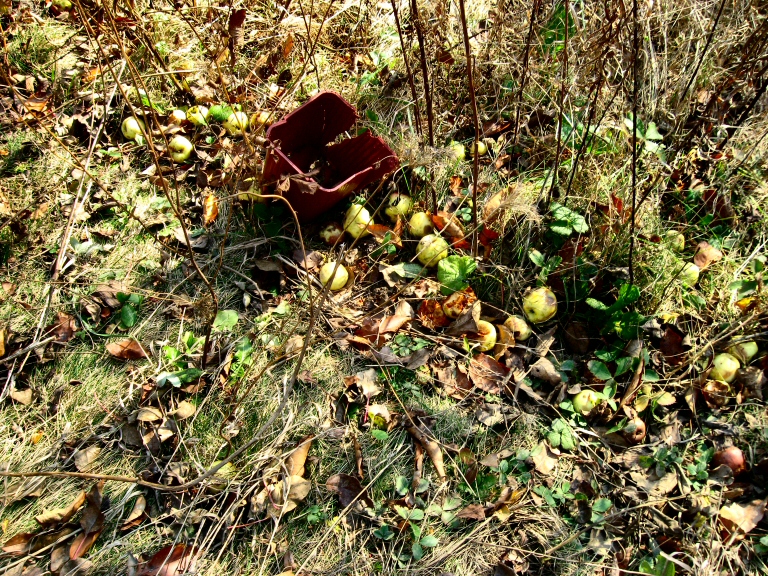

(Click for bigger versions.)
Enjoy this fall season on its way out!
Wednesday, October 21, 2009
chanson triste
I just came back from an awards ceremony. I placed for photography and won a small sum that I will frivol away in the next three weeks. The show was fairly boring, the pundit laughed at everything she said, and the judges were hacks who failed at their own careers.
It's a prestigious contest!
Anyway, I had kinda hoped to see some people there but they didn't come, so I stood on stage beside a spot of empty air and smiled at absolutely nothing.
Anyway, the photo is here: http://tinyurl.com/earlyharvestwin
It's a prestigious contest!
Anyway, I had kinda hoped to see some people there but they didn't come, so I stood on stage beside a spot of empty air and smiled at absolutely nothing.
Anyway, the photo is here: http://tinyurl.com/earlyharvestwin
Sunday, October 18, 2009
love is
Rachel of the Fields (the eponymous character in my novel) just shared with me this insight:
"There are so f---ing many different things said about love, so many things people claim it does and is, that it's a wonder anyone has any idea what the hell it is anymore. ... Well, I guess that's another good thing about it?"
Pardon her language (if I can speak for her); she gets worked up about the smallest things, like love...
"There are so f---ing many different things said about love, so many things people claim it does and is, that it's a wonder anyone has any idea what the hell it is anymore. ... Well, I guess that's another good thing about it?"
Pardon her language (if I can speak for her); she gets worked up about the smallest things, like love...
Thursday, October 08, 2009
Thursdays
On Thursdays, I come home early, namely, I leave school around 12:30 and get back at 2:00 (having to take public transit, since no one is off work that early to drive me and my useless hand). Because of this, I have also assigned it as the day when I can do extra things--answer policemen and lawyers' questions, visit the dentist, go downtown to deliver a package from my mom's work to some customer or other, to save time. As such, today is the... drumroll... first time I get to actually go straight home and enjoy having the house to myself for a couple hours!
Why, I think I'll do some homework then!
Why, I think I'll do some homework then!
Monday, September 21, 2009
expand:metaphor
The only word for university is "expansion". It does not replace. You are not moved away from the place you came from. Even if you are far, far away, it is still with you because it is you: the majority of everything you've ever done is in your past. Thus either you go forth totally unarmed, or rather you are more expanding to cover a greater area than being transplanted to flower somewhere else.
We have been awfully cramped. It was comfortable. There was almost not enough room for all of us, and so we, pressed closely together, turned into friends. Now the walls are open, and we all spilled out into a bigger box, a bigger world. In this spacious mindset, we stand with space between us; it now takes effort and will to magnetize each other. This is our drifting hour.
In the same way, we are like kittens whose eyes open after a certain time, and are born naked. The roof has come off, and the light is coming in. Our eyes adjust and, in our huge education, we are liable to be blinded. We cover ourselves up, being now standing in the light. There is so much light, so much visible--we are confused by the grear many new images. God help us distinguish.
That is the latter trouble, that it is very, very loud in the universities, in the bigger world, because everyone must make noise; a billion creatures mew for warmth, food, attention. Though it is a sweet sound, our God rarely speaks above a whisper; that is a sweeter noise, but I cannot hear it. And He knows where I ought to go, whereas I am trying to discern that from my fellow blind.
Well--it's a challenge, and the dead nerves are happily brought to life by an insensitive touch to a sensitive place. We are here to gain the things we lack--understanding, companionship, survivability--and it may be that it only seems that we lack these things here, because here we are given the ability to see the needs we always had.
Tuesday, August 25, 2009
and it's there
I'm not "whole" or whatever.
But I'm having a good time.
People always expect me to be in constant sadness, pain, regret, discomfort, or to be constantly worrying about my hand. I'm used to it now, but the last one was weird for a while. I'd be asked in line at the store, "Does that hurt?" and I'd think, "What, scratching my elbow?... Oh, right."
Thing is, I'm having a good time, most of the time. Maybe even better than before.
As a character in my novel-in-writing put it, "Life is in searching for reasons to live and making them make sense. We don't look for reasons to die... some people want to die, because they don't have enough reason to live. I feel so sorry for them, they have such a big need to satisfy. Some people are the opposite--it's just a few things they're in want of and they can be happy forever. But you and me, Rachel, we have to look for our reasons to live, day after day. I don't know what my reason is, but you know what? It's there. And it's there. They're everywhere, if that's your taste."
I think she (technically, I) was right, and the funny thing is, since this happened, I've found I have more reason to live (and happily), not less. It's like it's become easier to find the presence of God. Walking in the woods, on a leafy path across from the warm August sunset, or having someone open the church door for you, or smile and wish you well instead of bemoan your fate--I just forget about everything bad and feel, well, "whole".
Those who know me know that I had a share of emotional pain a while back (and the funny thing about that is it's exactly the same real or imagined), as a typical teenager (hah!). But until my accident I'd never experienced physical pain to speak of. It opened my eyes, really. You have to be blind or stupid to think the worst thing that can happen to you is unrequited love when you're 16, to reproach myself. And of course I'm getting off easy! I'll be fine in time!
There's a verse in the Bible where God says he will take those with him to heaven and restore them and make them holy. To be honest, I never felt like that was even... something I looked forward to. But once I had been broken, I realized I'm not whole, and I never was, and I need to be restored. I really need that healing, both for body and soul.
And it's there.
--
(Endnote: I also note some parallels between my healing and how we as Christians behave. In short, I give my time each day, every day, in 2-3 hours of painfully teaching my hand how the heck it's supposed to move, my fingers how to bend. Even if my body is repairing the structure, even if I believe and know it's true, this is a process that is impossible without pouring will and effort into it.
The interesting thing about it is that recently, my fingers have been feeling like moving and wiggling even in bandages under the cast, without my thinking about it. Doing the good work, whatever it might be, may at first seem like a "chore" or "something you have to do", but in time it becomes nature--or rather you realize that love and godliness is your nature, just as I am trying by great effort to restore my hand to its original... "whole"ness.)
But I'm having a good time.
People always expect me to be in constant sadness, pain, regret, discomfort, or to be constantly worrying about my hand. I'm used to it now, but the last one was weird for a while. I'd be asked in line at the store, "Does that hurt?" and I'd think, "What, scratching my elbow?... Oh, right."
Thing is, I'm having a good time, most of the time. Maybe even better than before.
As a character in my novel-in-writing put it, "Life is in searching for reasons to live and making them make sense. We don't look for reasons to die... some people want to die, because they don't have enough reason to live. I feel so sorry for them, they have such a big need to satisfy. Some people are the opposite--it's just a few things they're in want of and they can be happy forever. But you and me, Rachel, we have to look for our reasons to live, day after day. I don't know what my reason is, but you know what? It's there. And it's there. They're everywhere, if that's your taste."
I think she (technically, I) was right, and the funny thing is, since this happened, I've found I have more reason to live (and happily), not less. It's like it's become easier to find the presence of God. Walking in the woods, on a leafy path across from the warm August sunset, or having someone open the church door for you, or smile and wish you well instead of bemoan your fate--I just forget about everything bad and feel, well, "whole".
Those who know me know that I had a share of emotional pain a while back (and the funny thing about that is it's exactly the same real or imagined), as a typical teenager (hah!). But until my accident I'd never experienced physical pain to speak of. It opened my eyes, really. You have to be blind or stupid to think the worst thing that can happen to you is unrequited love when you're 16, to reproach myself. And of course I'm getting off easy! I'll be fine in time!
There's a verse in the Bible where God says he will take those with him to heaven and restore them and make them holy. To be honest, I never felt like that was even... something I looked forward to. But once I had been broken, I realized I'm not whole, and I never was, and I need to be restored. I really need that healing, both for body and soul.
And it's there.
--
(Endnote: I also note some parallels between my healing and how we as Christians behave. In short, I give my time each day, every day, in 2-3 hours of painfully teaching my hand how the heck it's supposed to move, my fingers how to bend. Even if my body is repairing the structure, even if I believe and know it's true, this is a process that is impossible without pouring will and effort into it.
The interesting thing about it is that recently, my fingers have been feeling like moving and wiggling even in bandages under the cast, without my thinking about it. Doing the good work, whatever it might be, may at first seem like a "chore" or "something you have to do", but in time it becomes nature--or rather you realize that love and godliness is your nature, just as I am trying by great effort to restore my hand to its original... "whole"ness.)
Sunday, August 16, 2009
carry-on
I have a conversation that follows me wherever I go...
An amusing/thoughtful comic by Tim Kreider, who was stabbed and survived:
http://www.urbanitebaltimore.com/pdf/stabbingstory_1_0808.pdf
It's similar to that;
"What the heck happened to your HAND??"
Siiiiiigh.
"Well, I was on my bike and a car hit me."
"WHAT?! OH MY GOODNESS!"
"No, no, I'll be fine in a month or so."
"Oh, you poor boy! That's criminal! You should SUE!"
"Well, the bills will be paid for, and I'll be fine."
"My (insert possibly imaginary) acquaintance was (at some indistinct time) hurt, and (S)HE sued. Why, it's probably the same mad driver! Do you know, they should get drivers like that OFF the ROAD. Bob, did you hear about this kid? What a shameful waste! All because of people like THAT!"
"I'll be, uh, over here."
"WON'T ANYBODY THINK OF THE CHILDREN?!"
Moral: do not approach strangers when in a cast.
An amusing/thoughtful comic by Tim Kreider, who was stabbed and survived:
http://www.urbanitebaltimore.com/pdf/stabbingstory_1_0808.pdf
It's similar to that;
"What the heck happened to your HAND??"
Siiiiiigh.
"Well, I was on my bike and a car hit me."
"WHAT?! OH MY GOODNESS!"
"No, no, I'll be fine in a month or so."
"Oh, you poor boy! That's criminal! You should SUE!"
"Well, the bills will be paid for, and I'll be fine."
"My (insert possibly imaginary) acquaintance was (at some indistinct time) hurt, and (S)HE sued. Why, it's probably the same mad driver! Do you know, they should get drivers like that OFF the ROAD. Bob, did you hear about this kid? What a shameful waste! All because of people like THAT!"
"I'll be, uh, over here."
"WON'T ANYBODY THINK OF THE CHILDREN?!"
Moral: do not approach strangers when in a cast.
Sunday, August 09, 2009
thank you sir you are very kind
One of the things the doctors tell me a lot is "Well, that's what happens when you get hit by a car." Oh, really? Wonderful. I thought it wasn't. But it seems so... purposeless. Yes, I understand that, given the car, this is natural. But why the car in the first place? That's the questioniola. Is getting hit by a car "what happens when you live normally"? I don't think so! This is a really weird way of encouraging someone.
"We-e-ell, don't you worry! This is what happens when you get hit by a car."
"Thank you, sir, you are very kind."
"We-e-ell, don't you worry! This is what happens when you get hit by a car."
"Thank you, sir, you are very kind."
Saturday, August 08, 2009
the recovery thoughtset
Well, we've hit the three-week mark. That's halfway to being able to chew again and having my pins out (which means serious physiotherapy begins). The origins of the story are old news now, and get mentioned in better detail below anyway. When the physical pain passes, and for the most part it has, you have to do something with your time. My mind is wandering a lot of the time, and it goes through phases.
The first is the helpless or self-pity, and it's awfully stupid but addictive. It says, "Now I can't do anything for myself, I need help, I ought to be the centre of attention and sympathy." In truth, most of what I can't do involves opening stuff. Piano is just entertainment, carrying stuff just takes longer, and typing is... uh, well it's less error-prone. I need help in two things: being driven places and learning how to heal my hand without permanent side effects. I've always needed the first, and I'm getting both anyway. As for attention and sympathy, ask my friends or family - they're giving it by the bucketload. And the kicker? None of this damage (probably) will even be with me in a year; it'll be scars at most. And between now and then I'm getting a lot of free lunches.
The second phase is regret.
It's hard to get around regret, because it was just so darn stupid how it happened. Before I went, my dad stopped me to talk to me and said, "You should fix your bike's front tire; your brother's has bad brakes and it's raining. If you had to, you might not be able to brake." I gotta say, if there is a clearer warning from the heavens, I don't know what it is. What did I reply? "No, I don't feel like fixing mine right now, and Mom's bike's seat is too low, and I have to go on this bike ride now."
Oh, come on! I "have" to? Mistake #1. Either that was just plain old hubris or fate got a fork stuck in its eye. At any rate it was a bad move. I even remember how I felt that day: as I was biking down Mountainview, I felt like the bike ride had been in vain, a waste of time. I didn't enjoy it. I thought I'd go on down to Norval and then just head home and admit to myself that going on a bike ride at that particular moment had not been imperative. When the car pulled up to the sidewalk and failed to look, that's what I was thinking about; I didn't notice her face, or I might have realized she didn't see me. Mistake #2.
Then I saw that I was going to hit the car, and at an angle that it was plowing into me. With the busy road to my right, I had three choices: ditch the bike, swerve to the left onto the grass, or try to brake in the couple meters I had. I didn't have time to think. I chose to brake real hard. There are skid marks. Mistake #3: no brakes could have stopped the bike, or at least not without me flying forward off it, least of all those brakes.
When I hit that car, I released my right hand from the handlebar. The handlebar was crushed under the wheel of the car. My left hand was on it, gripping the brakes. Mistake #4. But that one was just cuz I was in shock.
I've been beating myself up about that, because at any one of those times I could have made a tiny change and saved myself a ton of pain, past and to come. I guess blaming myself makes a nice balance for the pity. It evens it out.
The third phase is phantom pain. I'm pretty sure it's psychosomatic (where what happens in your mind affects you physically). Sometimes I swear I can feel the pins in my hand, and there are six of them through my palm and fingers now, holding the bone in place. I want to tell you the story of the anaesthetic from my second surgery, because it was one of the most weird and horrible times of my life and it feels like it's behind a lot of the waking up in the middle of the night that I do these days, during which times of wakefulness these "phantom pains" appear.
Okay, so we're at the hospital eating an Aero bar, me and my mom. Six hours later, a doctor is saying "HOLY CRAP YOUR HAND IS BAD HOW DID THEY MISS THAT HOLY YOU NEED SURGERY AS SOON AS POSSIBLE GOGOGO GO GOOOOOOO." And an hour after that, a doctor is saying "I'm going to put you under now; ah, have you eaten anything in the last twenty-four hours?"
I had eaten an Aero bar.
The next thirty minutes were spent over about five hours. Doesn't make sense? Okay, fifteen minutes conscious before the surgery and the next conscious fifteen happened immediately five hours later. I was conscious while they slowly moved a long plastic tube down my throat and back up five times to empty my stupid stomach until I could finally be put to sleep, and right from there to a horrible loud bawling in the recovery ward that, hint hint, was from me. The pain wasn't even that bad, and my throat was explainably sore.
"I'm sorry, I'm sorry," I begged as I regained consciousness and tears streamed down my face, "I'm so sorry..."
"You're not crying, don't worry, it's just the waking up," said the nurse.
By the way, last time I woke up it was fun.
Also, I'm sure I wasn't apologizing for the crying. So for what?
Is this just insanity, stubbornness, ignorance, or is there something behind it? Either way, it's been bothering me, and when I think about it, I'm back on the stretcher, choking on a long plastic tube scraping somewhere deep inside me, and on my own vomit.
The final phase my mind drifts through is philosophical thinking, but I don't trust it because 1. a few hours later the great insights I had are gone and 2. it's usually after taking pain pills. The hours of pain pills follow a pattern; the first hour is drowsy, the second is nauseous (though I'm often napping by then), the third is philosophical and the fourth is dizzy, during which my head is cleared of the previous while.
That's not so much the issue, that I have the philosophical times. I enjoy them. I feel like I'm being very productive. I accept who I am and what state I'm in. Heck, I'm in one right now. What I don't like is afterward when I can't remember why I waste every moment of my day doing nothing but sleeping, healing, playing games, checking the mailbox, annoying everyone by playing only the right hands of songs on the piano. It makes me wonder, when I'm on pain pills, if it's easy enough to be happy in regular life.
Masochism?
Anyway, I've been very glad to unload all this rambling, and I chose the word "thinkset" instead of "mindset" because... I can? In summary, my problems nicely cancel each other out:
--Pity for self.
--NOPE! Blame myself.
--Mind in agony at specific times.
--NOPE! Lovely temporary cushion.
The thing is, I hate it.
Three more weeks. Halfway. Till serious physiotherapy.
Reminder to self: God is merciful. I could be dead!
The first is the helpless or self-pity, and it's awfully stupid but addictive. It says, "Now I can't do anything for myself, I need help, I ought to be the centre of attention and sympathy." In truth, most of what I can't do involves opening stuff. Piano is just entertainment, carrying stuff just takes longer, and typing is... uh, well it's less error-prone. I need help in two things: being driven places and learning how to heal my hand without permanent side effects. I've always needed the first, and I'm getting both anyway. As for attention and sympathy, ask my friends or family - they're giving it by the bucketload. And the kicker? None of this damage (probably) will even be with me in a year; it'll be scars at most. And between now and then I'm getting a lot of free lunches.
The second phase is regret.
It's hard to get around regret, because it was just so darn stupid how it happened. Before I went, my dad stopped me to talk to me and said, "You should fix your bike's front tire; your brother's has bad brakes and it's raining. If you had to, you might not be able to brake." I gotta say, if there is a clearer warning from the heavens, I don't know what it is. What did I reply? "No, I don't feel like fixing mine right now, and Mom's bike's seat is too low, and I have to go on this bike ride now."
Oh, come on! I "have" to? Mistake #1. Either that was just plain old hubris or fate got a fork stuck in its eye. At any rate it was a bad move. I even remember how I felt that day: as I was biking down Mountainview, I felt like the bike ride had been in vain, a waste of time. I didn't enjoy it. I thought I'd go on down to Norval and then just head home and admit to myself that going on a bike ride at that particular moment had not been imperative. When the car pulled up to the sidewalk and failed to look, that's what I was thinking about; I didn't notice her face, or I might have realized she didn't see me. Mistake #2.
Then I saw that I was going to hit the car, and at an angle that it was plowing into me. With the busy road to my right, I had three choices: ditch the bike, swerve to the left onto the grass, or try to brake in the couple meters I had. I didn't have time to think. I chose to brake real hard. There are skid marks. Mistake #3: no brakes could have stopped the bike, or at least not without me flying forward off it, least of all those brakes.
When I hit that car, I released my right hand from the handlebar. The handlebar was crushed under the wheel of the car. My left hand was on it, gripping the brakes. Mistake #4. But that one was just cuz I was in shock.
I've been beating myself up about that, because at any one of those times I could have made a tiny change and saved myself a ton of pain, past and to come. I guess blaming myself makes a nice balance for the pity. It evens it out.
The third phase is phantom pain. I'm pretty sure it's psychosomatic (where what happens in your mind affects you physically). Sometimes I swear I can feel the pins in my hand, and there are six of them through my palm and fingers now, holding the bone in place. I want to tell you the story of the anaesthetic from my second surgery, because it was one of the most weird and horrible times of my life and it feels like it's behind a lot of the waking up in the middle of the night that I do these days, during which times of wakefulness these "phantom pains" appear.
Okay, so we're at the hospital eating an Aero bar, me and my mom. Six hours later, a doctor is saying "HOLY CRAP YOUR HAND IS BAD HOW DID THEY MISS THAT HOLY YOU NEED SURGERY AS SOON AS POSSIBLE GOGOGO GO GOOOOOOO." And an hour after that, a doctor is saying "I'm going to put you under now; ah, have you eaten anything in the last twenty-four hours?"
I had eaten an Aero bar.
The next thirty minutes were spent over about five hours. Doesn't make sense? Okay, fifteen minutes conscious before the surgery and the next conscious fifteen happened immediately five hours later. I was conscious while they slowly moved a long plastic tube down my throat and back up five times to empty my stupid stomach until I could finally be put to sleep, and right from there to a horrible loud bawling in the recovery ward that, hint hint, was from me. The pain wasn't even that bad, and my throat was explainably sore.
"I'm sorry, I'm sorry," I begged as I regained consciousness and tears streamed down my face, "I'm so sorry..."
"You're not crying, don't worry, it's just the waking up," said the nurse.
By the way, last time I woke up it was fun.
Also, I'm sure I wasn't apologizing for the crying. So for what?
Is this just insanity, stubbornness, ignorance, or is there something behind it? Either way, it's been bothering me, and when I think about it, I'm back on the stretcher, choking on a long plastic tube scraping somewhere deep inside me, and on my own vomit.
The final phase my mind drifts through is philosophical thinking, but I don't trust it because 1. a few hours later the great insights I had are gone and 2. it's usually after taking pain pills. The hours of pain pills follow a pattern; the first hour is drowsy, the second is nauseous (though I'm often napping by then), the third is philosophical and the fourth is dizzy, during which my head is cleared of the previous while.
That's not so much the issue, that I have the philosophical times. I enjoy them. I feel like I'm being very productive. I accept who I am and what state I'm in. Heck, I'm in one right now. What I don't like is afterward when I can't remember why I waste every moment of my day doing nothing but sleeping, healing, playing games, checking the mailbox, annoying everyone by playing only the right hands of songs on the piano. It makes me wonder, when I'm on pain pills, if it's easy enough to be happy in regular life.
Masochism?
Anyway, I've been very glad to unload all this rambling, and I chose the word "thinkset" instead of "mindset" because... I can? In summary, my problems nicely cancel each other out:
--Pity for self.
--NOPE! Blame myself.
--Mind in agony at specific times.
--NOPE! Lovely temporary cushion.
The thing is, I hate it.
Three more weeks. Halfway. Till serious physiotherapy.
Reminder to self: God is merciful. I could be dead!
Sunday, July 26, 2009
h[and/or] jaw
ok, so I am finally writing about my hand, which probably everyone knows about. on Friday, July 17, I was biking around a little on Mountainview when an ancient old lady was pulling out of a gas station. a man across the way crossed too, and I thought she was stopped for him, but he waved her to go. she never looked my way. it was too late to really brake. I slammed into the front of the car with my jaw, but then my bike got pulled under the car, and me on it - more specifically, my left hand on the brake. it got mangled while she continued to drive for twenty feet. afterwards, I got up and stumbled over to the grass strip, where someone called 911 and my house. I was in the hospital for eight hours. since then I have had several casts, a surgery and a lot of painkillers.
my jaw will probably be okay without surgery or wires; the next four weeks will be all soft foods and liquids (you should try these meal replacement shakes). my hand, however, remains in great pain. lots of physiotherapy to come. we shall see how this all turns out. meanwhile I am grateful for the use of my right hand. wish me luck in the coming weeks.
that's all for now!
my jaw will probably be okay without surgery or wires; the next four weeks will be all soft foods and liquids (you should try these meal replacement shakes). my hand, however, remains in great pain. lots of physiotherapy to come. we shall see how this all turns out. meanwhile I am grateful for the use of my right hand. wish me luck in the coming weeks.
that's all for now!
Friday, July 17, 2009
ahead
For some reason I feel like meeting new people.
I also feel like seeing all my old friends.
These two things do not usually coexist with me!
Sarah was saying, while school was still on, "But I don't want to meet new people. I like the friends I have now!" and I agreed totally. And still do, in a way. But recently I've somehow gained the desire to see someone I've never met, and become friends with them.
Generous gift of God, for someone going into a totally unfamiliar place in the fall. Ai - it's still so daunting. But hey, I'll be meeting new people!
I also feel like seeing all my old friends.
These two things do not usually coexist with me!
Sarah was saying, while school was still on, "But I don't want to meet new people. I like the friends I have now!" and I agreed totally. And still do, in a way. But recently I've somehow gained the desire to see someone I've never met, and become friends with them.
Generous gift of God, for someone going into a totally unfamiliar place in the fall. Ai - it's still so daunting. But hey, I'll be meeting new people!
Subscribe to:
Posts (Atom)